

Peace in the Pews
Peace in the Pews
A Holistic Guide to Resolving Conflicts in Multicultural Congregations
GuiChun Jun
2025 | 144pp pb | ISBN: 978‐1‐917059‐51‐0
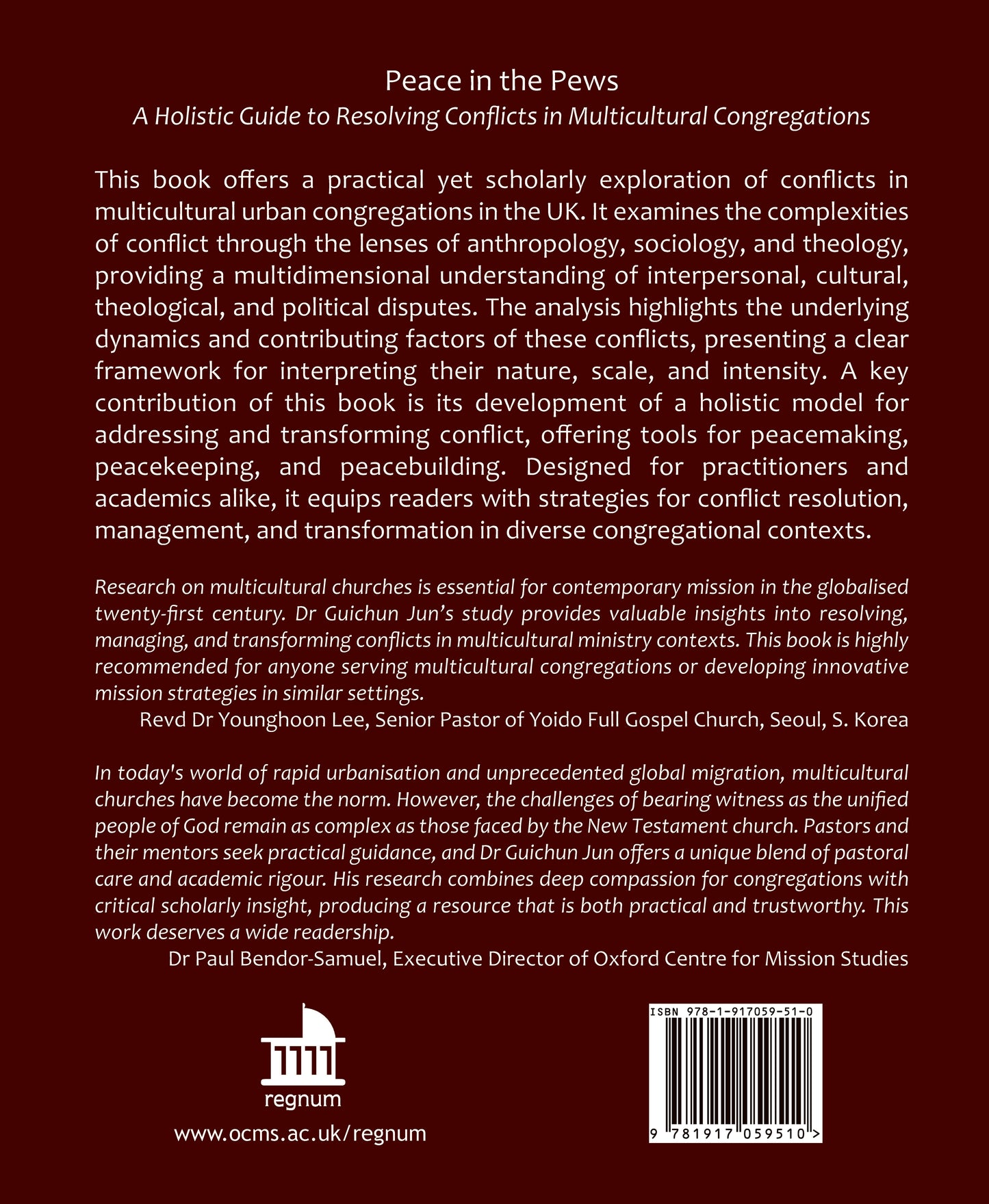
This book offers a practical yet scholarly exploration of conflicts in multicultural urban congregations in the UK. It examines the complexities of conflict through the lenses of anthropology, sociology, and theology, providing a multidimensional understanding of interpersonal, cultural, theological, and political disputes. The analysis highlights the underlying dynamics and contributing factors of these conflicts, presenting a clear framework for interpreting their nature, scale, and intensity. A key contribution of this book is its development of a holistic model for addressing and transforming conflict, offering tools for peacemaking, peacekeeping, and peacebuilding. Designed for practitioners and academics alike, it equips readers with strategies for conflict resolution, management, and transformation in diverse congregational contexts.
Table of Contents
Table of Contents
CONTENTS:
Introduction 1
Theoretical Background 5
Interpersonal Behavioural Conflict 15
Cultural Conflict 31
Theological Conflict 53
Micro‐level of Political Conflict 73
Conflict Approaches 89
Integrated Approach to Handling Conflicts 101
Summary and Conclusion 127
About the Author
About the Author
ABOUT THE AUTHOR:
GuiChun Jun is a theologian and practitioner with extensive experience in multicultural ministry. Since moving to the UK in 2003, he has led diverse urban congregations in Birmingham and London. He earned his doctorate at the Oxford Centre for Mission Studies (OCMS) in 2016, where he now serves as a research tutor and the OCMS Stage Leader. His work focuses on uncovering local knowledge from specific congregational contexts to enhance ministry and mission. By exploring the lived realities of church members, he integrates theological insight with practical applications.
QUESTIONS TO THE AUTHOR ABOUT THE BOOK:
Why did you decide to write your book?
This book was written in response to my experiences in pastoral ministry within a multicultural congregation, where conflicts arose due to differences in cultural, theological, and social backgrounds. The research aimed to provide both theoretical insights and practical frameworks for understanding and resolving such conflicts. Having no prior experience in a multicultural setting, the author sought to equip both himself and other church leaders with the skills necessary to manage complex congregational dynamics effectively. The study was not only intended to address immediate challenges in the local church but also to offer insights that could support other leaders facing similar issues in diverse faith communities.
What is distinctive about the content of your book?
The book integrates sociological and theological perspectives to develop a systematic approach to conflict resolution in a multicultural church setting. It categorises conflicts into macro and micro-level issues, addressing matters of cultural identity, theological disputes, political struggles, and ethical tensions. A particularly distinctive feature is the “holistic model”, which provides theoretical frameworks, typologies for different conflicts, and practical strategies for resolution. The book critiques existing models of unity, such as C.S. Lewis’s concept of “mere Christianity”, and proposes a revised approach that promotes practical coexistence within diversity.
Why is this subject important?
Understanding and managing conflicts in multicultural congregations is crucial for church unity, effective ministry, and long-term sustainability. As globalisation fosters increasingly diverse church communities, unresolved conflicts can hinder spiritual growth, cause divisions, and weaken the church’s witness. By addressing these issues, the book contributes to peace-building efforts within congregations and equips leaders with the tools to foster reconciliation and inclusion. The research highlights how unresolved political and theological conflicts can undermine church governance and the effectiveness of its mission.
What difference would this book make for the ministry?
The book provides a structured and comprehensive approach to handling conflict that can be integrated into church leadership training, pastoral care, and ministry development. It offers a framework for diagnosing conflicts, selecting appropriate intervention strategies, and promoting reconciliation. By equipping leaders with a deeper understanding of conflict dynamics, the book enhances their ability to maintain congregational unity while respecting cultural and theological diversity. Furthermore, it encourages a shift away from hierarchical, top-down conflict management towards a more participatory, bottom-up approach that fosters genuine transformation.
Additional Relevant Insights
The book underscores the importance of recognising biases in conflict interpretation, both from leaders and congregation members. It also highlights the necessity of collaboration in research and practice, suggesting that a diverse team of cultural and conflict-resolution experts could enhance future studies.
Endorsements
Endorsements
This book offers a practical yet scholarly exploration of conflicts in multicultural urban congregations in the UK. It examines the complexities of conflict through the lenses of anthropology, sociology, and theology, providing a multidimensional understanding of interpersonal, cultural,
theological, and political disputes. The analysis highlights the underlying dynamics and contributing factors of these conflicts, presenting a clear framework for interpreting their nature, scale, and intensity. A key contribution of this book is its development of a holistic model for addressing and transforming conflict, offering tools for peacemaking,
peacekeeping, and peacebuilding. Designed for practitioners and academics alike, it equips readers with strategies for conflict resolution, management, and transformation in diverse congregational contexts.
Research on multicultural churches is essential for contemporary mission in the globalised twenty‐first century. Dr Guichun Jun’s study provides valuable insights into resolving, managing, and transforming conflicts in multicultural ministry contexts. This book is highly recommended for anyone serving multicultural congregations or developing innovative mission strategies in similar settings.
Revd Dr Younghoon Lee, Senior Pastor of Yoido Full Gospel Church, Seoul, S. Korea
In today's world of rapid urbanisation and unprecedented global migration, multicultural churches have become the norm. However, the challenges of bearing witness as the unified people of God remain as complex as those faced by the New Testament church. Pastors and their mentors seek practical guidance, and Dr Guichun Jun offers a unique blend of pastoral care and academic rigour. His research combines deep compassion for congregations with critical scholarly insight, producing a resource that is both practical and trustworthy. This work deserves a wide readership.
Dr Paul Bendor‐Samuel, Executive Director of Oxford Centre for Mission Studies
Additional Resources and Book Reviews
Additional Resources and Book Reviews
Share