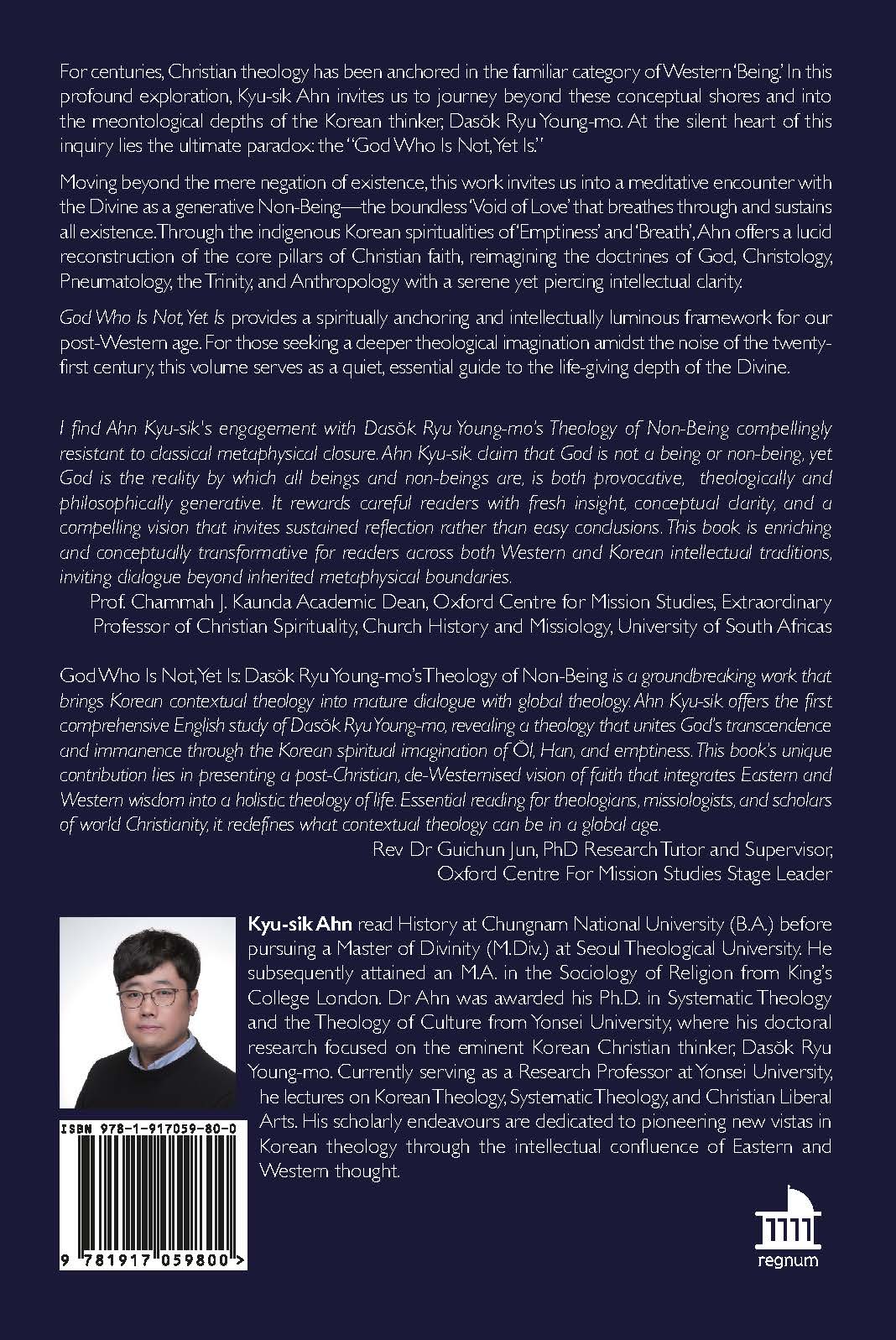


God Who Is Not, Yet Is
God Who Is Not, Yet Is
Kyusik Ahn
Dasŏk Ryu Youngmo’s Theology of Non-Being
2026 | 298pp pb | ISBN: 978-1-917059-80-0
For centuries, Christian theology has been anchored in the familiar category of Western ‘Being.’ In this profound exploration, Kyu-sik Ahn invites us to journey beyond these conceptual shores and into the meontological depths of the Korean thinker, Dasŏk Ryu Young-mo. At the silent heart of this inquiry lies the ultimate paradox: the “God Who Is Not, Yet Is.”
Moving beyond the mere negation of existence, this work invites us into a meditative encounter with the Divine as a generative Non-Being—the boundless ‘Void of Love’ that breathes through and sustains all existence. Through the indigenous Korean spiritualities of ‘Emptiness’ and ‘Breath’, Ahn offers a lucid reconstruction of the core pillars of Christian faith, reimagining the doctrines of God, Christology, Pneumatology, the Trinity, and Anthropology with a serene yet piercing intellectual clarity.
God Who Is Not, Yet Is provides a spiritually anchoring and intellectually luminous framework for our post-Western age. For those seeking a deeper theological imagination amidst the noise of the twenty-first century, this volume serves as a quiet, essential guide to the life-giving depth of the Divine.
Table of Contents
Table of Contents
CONTENTS:
Abbreviations vii
Glossary ix
Note on Translation and Romanisation xv
Foreword xvii
Preface 1
1. Korean Theology and Dasŏk Ryu Young-mo 21
2. The God of Oneness in Unity with the World 41
3. Christ as the Identity of Believers 103
4. Ŏl · Sum · Qim Pneumatology 147
5. Three Powers Theory and Dasŏk’s Doctrine of the Trinity 173
6. Dasŏk’s Performative-Aesthetical Anthropology 199
7. Dasŏk’s Theology in the Age of Post-Christianity 233
8. Conclusion: The Face of God Manifest in Korean Spirituality 257
References 265
Index 275
About the Author
About the Author
ABOUT THE AUTHOR:
Kyu-sik Ahn read History at Chungnam National University (B.A.) before pursuing a Master of Divinity (M.Div.) at Seoul Theological University. He subsequently attained an M.A. in the Sociology of Religion from King’s College London. Dr Ahn was awarded his Ph.D. in Systematic Theology and the Theology of Culture from Yonsei University, where his doctoral research focused on the eminent Korean Christian thinker, Dasŏk Ryu Young-mo. Currently serving as a Research Professor at Yonsei University, he lectures on Korean Theology, Systematic Theology, and Christian Liberal Arts. His scholarly endeavours are dedicated to pioneering new vistas in Korean theology through the intellectual confluence of Eastern and Western thought.
QUESTIONS TO THE AUTHOR ABOUT THE BOOK:
1. Why did you decide to write your book?
I resolved to write this monograph to demonstrate how Christian theology can be authentically constructed upon the foundation of East Asian philosophical traditions. Historically, the Christianity transmitted to non-Western societies, including Korea, has often been identified with the epistemological frameworks of Western civilisation or historically conditioned Western Christianity. Consequently, non-Western churches and theologies have suffered a regrettable absence of an indigenous ‘self-theology’. Thus, I sought to overcome these limitations by illuminating and systematically configuring the thought of Dasŏk Ryu Young-mo (다석 류영모, 1890–1981)—who can be considered a unique Korean thinker and Christian philosopher—from a theological perspective. Therefore, the primary objective of this book is to introduce ‘Korean theology’, which is the theological fruit of a ‘mutual illumination’ between the Christian Gospel, East Asian philosophical concepts from Confucianism, Buddhism, and Daoism, as well as indigenous Korean thought, thereby demonstrating that Korea’s unique cultural heritage can serve as an excellent theological framework for containing universal Christian truths. Furthermore, it aims to prove that the Korean cultural heritage can profoundly enrich the interpretation of Christian theology. Under this objective, I intended to introduce the Ontology of Non-Being—a mode of thought entirely distinct from the Being-centred paradigms that undergird traditional Western theology, and which forms the very foundation of the thought and language of the unique Korean Christian philosopher, Dasŏk Ryu Young-mo. In particular, I intended for Dasŏk Ryu Young-mo’s theology of Non-Being to offer readers in the Anglophone world, including the United Kingdom, a fresh and open theological imagination for perceiving God, the world, and humanity beyond the familiar boundaries of Western onto-theology, thereby establishing a generative bridge between Western and Asian theologies.
2. What is distinctive about the content of your book?
The definitive distinctiveness of this monograph lies in its radical departure from the metaphysics of ‘Being’ that has steadfastly dominated Western Christian theology since Augustine and Thomas Aquinas. This book offers a novel theological prism designated as the ‘Ontology of Non-Being’, grounded in the East Asian traditional concepts of nothingness, emptiness, and void, thereby providing three entirely unprecedented modes of thought and perspective that stand in stark contrast to Western theology. First is a non-substantialist God-model characterised by openness and indeterminacy. Traditional Western theology has conventionally defined God as immutable ‘Being Itself’ (Ipsum Esse) and an eternally imperishable, absolute substance (Essentia). Consequently, dimensions ungraspable by human reason and language have historically been relegated to mere privation or absence. Conversely, Dasŏk’s ontology of Non-Being established in this book refuses to objectify the Divine into a fixed substance, arriving instead at this realisation through a thorough deconstruction of self-negation. Instead, the Divine manifests as boundless ‘openness’ and ‘indeterminacy’ that cannot be exclusively captured, disclosing a non-substantialist self-revelation of paradoxical fullness—Boundless Emptiness (Bintang)—that embraces all reality. Second is the dynamism of ‘Oneness’ grounded in cosmic becoming and a non-originality that rejects any fixed spatiotemporal origin. Mainstream Western theology, including figures such as Karl Barth, has fundamentally tended to demonise nothingness (nihil) as an antagonistic force hostile to the Creator’s will, or as a mere lack of value. However, the ontology of Non-Being presented in this volume resonates deeply with process philosophy, reinterpreting ‘Non-Being’ through the lens of cosmic becoming and a non-originality that rejects any fixed spatiotemporal origin. God is not a ‘transcendent origin’ who rules over the world from behind a rigid boundary of asymmetrical causality. Rather, the Divine is constituted as an immanent transcendence that organically participates, suffers, and grows within the creative processes of the world, transcending both being and non-being to achieve a non-dualistic identity with the cosmos. Third is a performative-aesthetic transformation of the subject transcending dogmatic intellect. While Western theology has largely dogmatised ontological statements about God and objectified them as intellectual knowledge, Dasŏk’s ontology of Non-Being directly links the cognition of the Divine with the human subject’s radical kenotic self-emptying and corporeal performance. Through rigorous, self-powered ascetic disciplines such as centre-pointing (Gaon-jjikgi), one-sitting (il-jwa), and one-meal-a-day (il-sik), the practitioner confronts the distorted delusions of beauty pursued by the secular world—namely, greed, hatred, and ignorance. By deconstructing the false ego, the book reveals how the sacred ‘Õl’ (Spirit-Life) hidden within the human interior is paradoxically birthed as the authentic subject—the True Self (Cham-na)—which constitutes the very identity of Christ. In this manner, this volume exquisitely demonstrates that indigenous Korean concepts such as Õl and Samjaeron transcend the boundaries of localised theology to serve as a viable alternative and a global discourse to Western substantialist metaphysics.
3. Why is this subject important?
The distinctiveness of the ‘Ontology of Non-Being’ articulated above holds paramount importance in expanding the horizons of contemporary Christian theology and addressing the existential crises of modern society across four key dimensions. First is the overcoming of the critical limitations of Western substantialist onto-theology. Conventional Western onto-theology, which has absolutised fixed ‘Being’ and substance, has historically exhibited an insularity by excluding dimensions ungraspable by human reason and language as nihil, evil, or privation. Through the meontological prism of ‘the God who is not, yet is’, this book enables a more comprehensive and holistic theological discourse. Second is providing a new theological paradigm suited for the age of de-Westernisation and de-colonialism. Today, the global demographic landscape of Christianity is undergoing a rapid restructuring toward the non-Western global South, demanding a departure from traditional Western epistemological hegemony. This study, which creatively synthesises East Asian thought and Korean spirituality with the Gospel, transcends the constraints of Western history and metaphysics to discover the universal wisdom of Christ active prior to the introduction of Western Christianity, thus establishing an autonomous, ‘post-Christian’ global discourse. Third is healing the pervasive fragmentation and alienation within modern society. In contemporary times, individuals suffer from acute self-alienation, loss of selfhood, and profound relational fragmentation within a hyper-competitive, self-exploitative ‘performance society’. The discourse of Oneness, which dismantles the dichotomous fracturing between God and world or transcendence and immanence, overcomes ecological crises and religious exclusivism, offering insights that carry a potent practical paradigm to guide all creation toward peaceful, compassionate co-existence. Fourth is presenting a model for the radical transformation and spiritual maturity of local ministry. This subject is not a theology confined to abstract academic isolation. Instead, it liberates congregants from a utilitarian, transactional, or prosperity-oriented view of faith, guiding them to profoundly trust the Divine presence operating precisely within life’s moments of absence, silence, and suffering, thereby transforming local ministry through kenotic contemplative prayer and the formation of a mature, authentic Christian subject (the True Self).
4. What difference would this book make for the ministry?
The insights of Dasŏk presented in this volume offer a transformative pastoral paradigm capable of radically reshaping both spiritual formation and social praxis within local ministries. Specifically, Dasŏk’s ‘performative-aesthetic anthropology’ and ‘universal redemptive atonement’ supply powerful new insights to recover the core essence and depth that institutionalised churches have long lost. Primarily, this book yields insights into spiritual formation based on performative-aesthetic anthropology. Dasŏk’s performative-aesthetic anthropology converts local spiritual formation ministries from passive doctrinal instruction into an active ‘faith-based performance’. This transition manifests in three ways. First is a subversive confrontation with secular values. Performative-aesthetic anthropology sounds a clarion call to ensure that contemporary individuals are not subsumed by the deceptive, illusionary beauty engineered by the secular world’s three poisons of greed, hatred, and ignorance. From this perspective, believers can discover the counter-cultural, subversive modes of thought inherent in emptying and non-being (nothingness and emptiness). Second is life as a subversive performance art of the Spirit. For Dasŏk, spiritual discipline is a process of transforming the subject to accord with divine truth. This book demonstrates that an ascetic life of self-negation and contemplative thinking, which carves the True Self (Cham-na, 참나) into the fabric of daily life, is itself a high form of performative ‘art’ that discloses the subversive beauty of the Spirit. Third is the spirituality of a contemplative daily practitioner. Christians are envisioned not as passive religious consumers who merely gather within church walls for weekly comfort, but can discover a vision to become performative-aesthetic human subjects who unceasingly breathe the transcendent immanence of God through ‘centre-pointing’ and contemplative thinking in their everyday lives. Furthermore, this book provides a vision for social responsibility and ‘ministerial solidarity’ through the concept of universal atonement. Dasŏk’s teachings on universal redemptive suffering compel local ministries to move beyond parochial insularity and religious narcissism, constructing a ‘redemptive solidarity’ that actively participates in the world’s pain across three spheres. First is the soteriological rediscovery of suffering. Grounded in the concepts of vocation and uprightness, Dasŏk’s theology of atonement expands Christ’s vertical redemption into the horizontal spheres of the believer’s daily life. It endows ministry with an alternative lens to interpret incidental suffering or historical trauma not as a meaningless curse, but as a meaningful participation in the universal continuum of redemptive cosmic solidarity. Second is voluntary solidarity with the suffering of the Other. It guides congregants to perceive the pain of others not as an external object separate from themselves, but to realise that the cosmos is a redemptive organism wherein we die for one another and live through one another. Consequently, it reorients the trajectory of ministry away from institutional growth or numerical expansion toward a voluntary participation and solidarity with the suffering masses (Ssial, 씨알) and marginalised others, establishing a renewed human subjectivity. Third is Gospel-centred hospitality and the formation of a redemptive church community. This book reminds the church that it must become a ‘redemptive locus of sacrifice’ that bears the burdens of others amidst structural injustice, exploitation, and fragmentation. By motivating believers to forge active solidarity with the poor and the weak in their everyday lives, it transforms the church into a living altar of peace and reconciliation that heals the brokenness of the world.
5. Feel free to add anything else you find relevant.
The ultimate invitation this monograph extends is to journey together into the ‘Eternal Evening’—the dimension of profound spiritual mystery and silence articulated by Dasŏk. This book demonstrates that East Asian and indigenous Korean cultural and philosophical frameworks are by no means in exclusive conflict with the Christian Gospel. Rather, through a critical yet creative ‘mutual illumination’ between the two traditions, we are enabled to gather the fragments overlooked by Western onto-theology, leading to a more complete and enriched articulation of ultimate reality. Ultimately, I wish to share with the Anglophone church the universal ‘Face of God’ (Peniel) brilliantly manifested through the intense history of suffering and self-emptying that defines Korean spirituality. It is my sincere hope that the fruit of this rigorous academic dialogue will present Western readers with a fresh, wondrous, and infinitely open theological imagination.
Endorsements
Endorsements
I find Ahn Kyu-sik's engagement with Dasŏk Ryu Young-mo’s Theology of Non-Being compellingly resistant to classical metaphysical closure. Ahn Kyu-sik claim that God is not a being or non-being, yet God is the reality by which all beings and non-beings are, is both provocative, theologically and philosophically generative. It rewards careful readers with fresh insight, conceptual clarity, and a compelling vision that invites sustained reflection rather than easy conclusions. This book is enriching and conceptually transformative for readers across both Western and Korean intellectual traditions, inviting dialogue beyond inherited metaphysical boundaries.
Prof. Chammah J. Kaunda Academic Dean, Oxford Centre for Mission Studies, Extraordinary Professor of Christian Spirituality, Church History and Missiology, University of South Africas
God Who Is Not, Yet Is: Dasŏk Ryu Young-mo’s Theology of Non-Being is a groundbreaking work that brings Korean contextual theology into mature dialogue with global theology. Ahn Kyu-sik offers the first comprehensive English study of Dasŏk Ryu Young-mo, revealing a theology that unites God’s transcendence and immanence through the Korean spiritual imagination of Ŏl, Han, and emptiness. This book’s unique contribution lies in presenting a post-Christian, de-Westernised vision of faith that integrates Eastern and Western wisdom into a holistic theology of life. Essential reading for theologians, missiologists, and scholars of world Christianity, it redefines what contextual theology can be in a global age.
Rev Dr Guichun Jun, PhD Research Tutor and Supervisor,
Oxford Centre For Mission Studies Stage Leader
Additional Resources and Book Reviews
Additional Resources and Book Reviews
Share