

Emplacing Globalisation
Emplacing Globalisation
Contextualising Mission in Settings of People, Places and Processes
John Cheong and Jonathan Ro
2025 | pb 319pp | ISBN: 978-1-917059-45-9
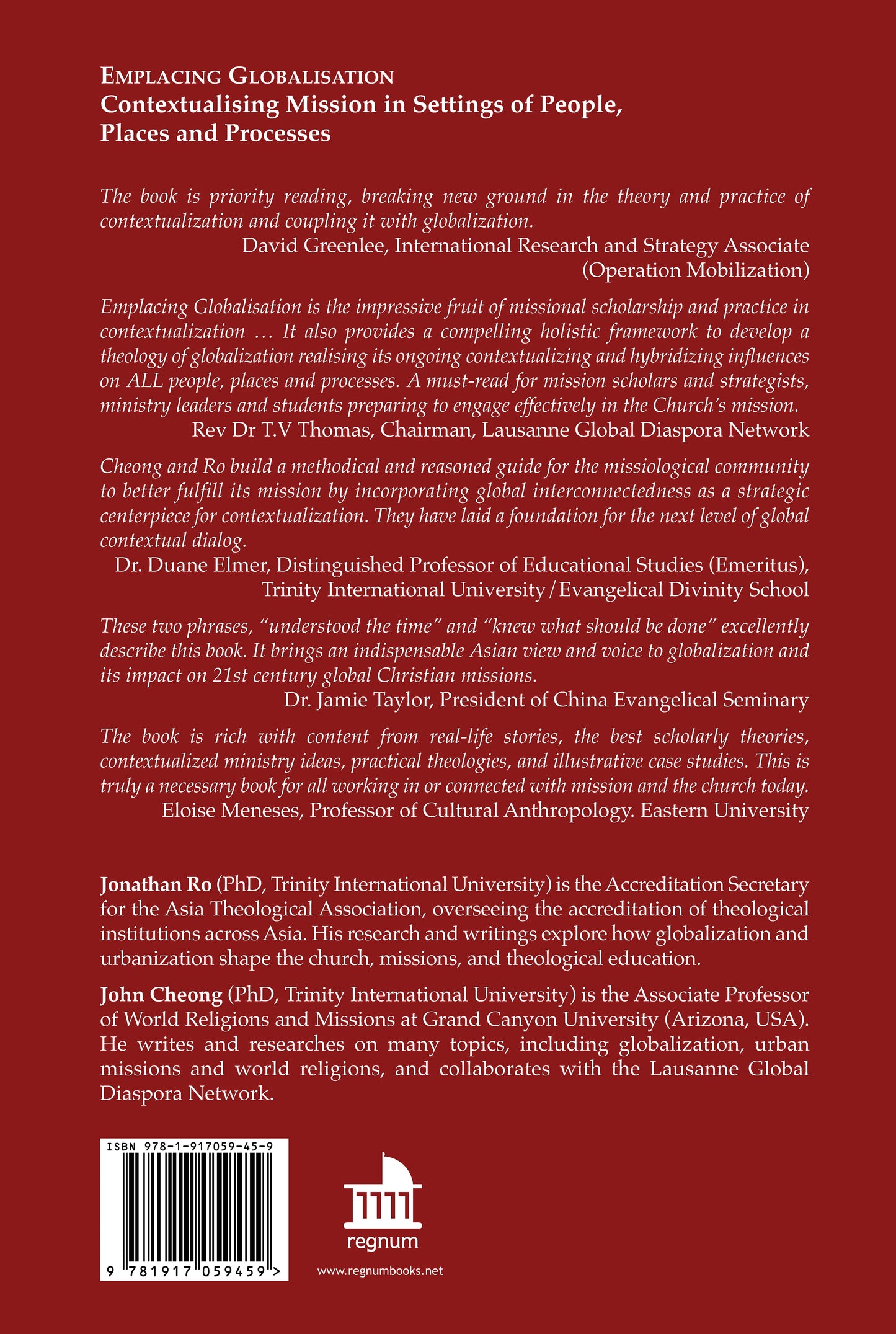
The book is priority reading, breaking new ground in the theory and practice of contextualization and coupling it with globalization.
David Greenlee, International Research and Strategy Associate
(Operation Mobilization)
Emplacing Globalisation is the impressive fruit of missional scholarship and practice in contextualization … It also provides a compelling holistic framework to develop a theology of globalization realising its ongoing contextualizing and hybridizing influences on ALL people, places and processes. A must-read for mission scholars and strategists, ministry leaders and students preparing to engage effectively in the Church’s mission.
Rev Dr T.V Thomas, Chairman, Lausanne Global Diaspora Network
Cheong and Ro build a methodical and reasoned guide for the missiological community to better fulfill its mission by incorporating global interconnectedness as a strategic centerpiece for contextualization. They have laid a foundation for the next level of global contextual dialog.
Dr. Duane Elmer, Distinguished Professor of Educational Studies (Emeritus), Trinity International University/Evangelical Divinity School
These two phrases, “understood the time” and “knew what should be done” excellently describe this book. It brings an indispensable Asian view and voice to globalization and its impact on 21st century global Christian missions.
Dr. Jamie Taylor, President of China Evangelical Seminary
The book is rich with content from real-life stories, the best scholarly theories, contextualized ministry ideas, practical theologies, and illustrative case studies. This is truly a necessary book for all working in or connected with mission and the church today.
Eloise Meneses, Professor of Cultural Anthropology. Eastern University
Table of Contents
Table of Contents
CONTENTS:
Acknowledgments xv
Foreword xvii
Preface xxi
THEOLOGISING WITH GLOBALISATION
1. Globalisation as Contextualisation 3
2. A Theology of Christian Mission and Globalisation 29
THEORISING WITH GLOBALISATION
3. Processes: The Flows and Chokepoints of Globalisation 51
4. The Affective Dimensions of Globalisation 69
5. Globalisation and the Flux of Human Identities 91
6. Global Social Capital: Position, Power and Privileges 123
7. Places of Influence and Structures in Globalisation 147
CASE STUDIES IN GLOBALISATION
8. Globalisation in the Ministry and Culture of the Church 173
9. Globalisation and Islam 195
10. Globalisation, Contextualisation and the Internet 213
CONCLUSION
11. Coda to Globalisation as Contextualisation in Mission 249
Bibliography 255
Subject Index 283
Scripture Index 293
About the Author
About the Author
ABOUT THE AUTHORS:
Jonathan Ro (PhD, Trinity International University) is the Accreditation Secretary for the Asia Theological Association, overseeing the accreditation of theological institutions across Asia. His research and writings explore how globalization and urbanization shape the church, missions, and theological education.
John cheong (PhD, Trinity International University) is the Associate Professor of World Religions and Missions at Grand Canyon University (Arizona, USA). He writes and researches on many topics, including globalization, urban
missions and world religions, and collaborates with the Lausanne Global Diaspora Network.
Endorsements
Endorsements
Emplacing Globalisation is the impressive fruit of missional scholarship and practice in contextualization. It issues a clarion call for a fresh critique of how the Church engages in Gospel-centred mission in a globalized world. It also provides a compelling holistic framework to develop a theology of globalization realising its ongoing contextualizing and hybridizing influences on ALL people, places and processes. They are glaringly amplified through global migration which results in the formation of diasporic communities, development of exilic consciousness and emergence of transnational identities. A must-read for mission scholars and strategists, ministry leaders and students preparing to engage effectively in the Church’s mission.
Rev. Dr T.V Thomas, Chairman Lausanne Global Diaspora Network
Some approaches to contextualization seem to take us back to a monocultural, isolated village. John Cheong and Jonathan Ro, however, “emplace” contextualization in the cities and even metaverses of the mid-21st centuries’ vibrant societies, shaped by hybridizing people and their continually changing cultures. Emplacing Globalization is priority reading, breaking new ground in
the theory and practice of contextualization and coupling it with globalization— not in its naively-optimistic but now-dead 1990s form, but as a process, lens, and
system shaping the world today for better or worse. Bravo! Highly commended!
David Greenlee, International Research and Strategy Associate (Operation Mobilization)
Combines penetrating analyses, social criticisms as well as deep theological insights for understanding how globalisation shapes Christian understanding of mission in our changing world. It demonstrates how missiology as an interdisciplinary study has shifted from history and culture to the importance of socio-cultural studies for analysing mission strategies and practices. The book
will have broad appeal to mission leaders and practitioners as well as students of mission, migration and sociology.
Tan Kang San, General Director of BMS World Mission (UK)
Emplacing Globalization is a clear reminder that globalization is a macro force that every attempt at theological contextualization must take into account.
Against the human tendency to move toward the micro socio-cultural context, the two authors, shaped through the globalization dynamic, convincingly argue for the global-local balance in theological and missional contextualization.
Wonsuk Ma, Distinguished Professor of Global Christianity, Oral Roberts University
While paying proper homage to the history of contextualization, the authors postulate a more global landscape for a more contemporary and more accurate
contextual process. Using insights from social science, the humanities and theology, Cheong and Ro build a methodical and reasoned guide for the missiological community to better fulfill its mission by incorporating global interconnectedness as a strategic centerpiece for contextualization. Cheong and Ro have laid a foundation for the next level of global contextual dialog. Read this book; discuss this book; then sharpen your practices.
Dr. Duane Elmer, Distinguished Professor of Educational Studies (Emeritus),
G. W. Aldeen Professor of International Studies (Retired)
Trinity International University/Evangelical Divinity School
In the book of 1 Chronicles, upon David’s ascension to the throne, the writer lists out the various tribes of Israel as they gathered together to establish David’s kingship. Amongst the list, the leaders of the tribe of Issachar are specifically described as being individuals who "understood the times” and “knew what the people should do”. These two phrases are also excellent expressions describing this book and how it brings a fresh and insightful perspective to both the reality
of globalization and how the fact of globalization must impact the practice of missions toward the fulfillment of the Great Commission. An added value to this landmark book is that it is authored by two Asians, thus bringing an
indispensable Asian view and voice to globalization and its impact on 21st century global Christian missions. As readers read and reflect on this fresh perspective of “Emplacing Globalization”, may the Lord of the Harvest truly raise up many 21st century men and women of Issachar, who both know the times we live in as well as the praxeology of missions we must engage in.
Dr. Jamie Taylor, President of China Evangelical Seminary
In this fascinating collaborative work, Emplacing Globalization, John Cheong and Jonathan Ro rightly identify the creative correlation between globalization and contextualization. Drawing insights from their transnational identity formation, the authors weave together various worldviews and world pictures across the world to illustrate their point. This landmark volume challenges dated perspectives and long-held stereotypes on the subject. To argue that globalization is the central framework for contextualization is both novel and bold; however, it is not pretentious, making this publication one of its kind. As skillful wordsmiths, Cheong and Ro navigate the intricacies of communicating and embodying biblical truth amid complex and globalizing societies today. In ten chapters, the authors unpack patiently and expertly the indispensable necessity of contextualization through the lens of globalization, including but not limited to migration, diaspora, and transnationalism. The book is a must read for missiologists, emerging scholars, seminary students, agency executives, church leaders, cross-cultural missionaries, and intercultural ministry practitioners.
Terry C. Casiño, Executive Director, DMin Program and Professor of Missiology & Intercultural Studies, School of Divinity, Gardner-Webb University, North Carolina
Cheong and Ro have written a truly excellent book, one that has greatly expanded my own thinking about the full implications of globalization for mission and the church. The book is rich with content from real life stories, the best scholarly theories, contextualized ministry ideas, practical theologies, and illustrative case studies. The breadth of the topics covered runs from global elements in contemporary worship music, to the impact of rationalization on management in churches, to the creation of internet communities for new Christians. Woven in are the authors’ own lived international and multi-national experiences, along with their own very fine scholarship. This is truly a necessary book for all working in or connected with mission and the church today.
Eloise Meneses, Professor of Cultural Anthropology. Eastern University
For too long mission leaders have conceptualized the work of making disciples of all nations in terms of exotic, distant ethnic groups that remain culturally isolated. That is not the world we inhabit. In Emplacing Globalization, Cheong and Ro have offered an important work to help us navigate 21st century missions. These two scholars bring a rare combination of academic scholarship with an abundance of day-to-day examples and case studies to aid the reader in processing the importance of globalization in our cultural analysis and the implications for missions today. I would encourage anyone serious about gospel engagement to read this book closely.
Michael D. Crane, Director of Radius Global Cities Network and Professor of Urban Mission in Southeast Asia
Emplacing Globalization provides us with a new lens in understanding and doing contextualization in Asia: one that addresses both the local culture in which people are immersed and the culture that stems from the impact of globalization. This book makes a compelling analysis of how globalization has affected the Asian communities and how churches can respond biblically and contextually to the many aspects of globalization in their contexts.
Continued and increasing globalization has contributed to a constantly fast changing world and so has serious implications for theological education and leadership development. Theological educators now need to constantly revisit and renew their curriculum to address the challenges and opportunities that beset the Asian Church and will need resources to aid them in that. I highly recommend this book as one of those resources. It will definitely be helpful in developing leaders for the mission of the church in the 21st century.
Dr. Theresa R. Lua, General Secretary, Asia Theological Association
For several years, the language of glocal has been with the Church. Our age has written a recipe where global and local realities mix to produce numerous bridges
and barriers for gospel advancement. While much missiological attention has been given to understanding local realities – and rightly so – for contextualization, globalization’s effect on the local often receives little
recognition. John Cheong and Jonathan Ro have produced a well-researched, scholarly treatise drawing our attentions toward the relationship of globalization
and contextualization. Emplacing Globalization takes readers on a journey that helps them recognize the influences of social and cultural dynamics in our
globalized world with a view toward understanding and stewarding well the local bridges while overcoming barriers.
J. D. Payne, Ph.D., Missiologist and Professor of Christian Ministry, Samford University, Birmingham, Alabama
For far too long, approaches to contextualization have assumed overly-simplistic understandings of the culture(s) that do not reflect the realities of people and
places in our globalized world. I'm delighted that in Emplacing Globalization, we have been given a steady guide that is sure to helpfully steer individuals,
churches and mission agencies to reflect on and re-assess the significance of globalization for their understanding and practice of mission in the complex
realities we face today.
Dr. David Ng, Program Leader for Master of Missional Leadership at Melbourne School of Theology
The book is a compelling and insightful exploration of the intricate relationship between globalization and identity formation. The authors adeptly illustrate how globalization serves as a dynamic framework for contextualization, challenging traditional notions of static cultural identities. As they profoundly put it, 'Globalization is ultimately about people and who they are that drive
globalization even as they are driven by it' (p. 7). It is essential for anyone seeking to understand the profound impacts of global interconnectedness on cultural and ethnic identities informed by a biblical worldview as well as contextual theologizing. Cheong and Ro's interdisciplinary approach and profound insights provide a critical perspective for both scholars and practitioners in the fields of missiology and global studies. As the authors assert, 'By studying how globalization affects people, globalization can serve as a key lens and process for contextualization' (p. 20), offering a fresh and necessary theological framework for engaging with the complexities of our globalized world.
Dr. Clement Chia, Principal of Singapore Bible College
Few would disagree that globalization has emerged as a dominant force shaping the modern world. Economics, politics, culture, media, entertainment, education,
healthcare, environment – all fundamental aspects of society are deeply impacted by the processes of globalization. Knowledge of the world is incomplete without scrutinizing the influences of globalization. It is therefore crucial for theology in general – and missiology in particular – to engage substantively with the
phenomenon of globalization. Cheong and Ro did just that. In their work, they put globalization into context, describing the processes and influences of
globalization on societies and individuals. They also put globalization into the contextualization of the Gospel, demonstrating how the mission and ministries of the Church can be effective in the context of globalization. It is a highly recommended read for those seeking to deepen their insight into this critical intersection.
Dr. Bernard Wong, President of China Graduate School of Theology
For too long, scholarship about contextualization has been hobbled by the notion that indigeneity or authenticity requires drawing primarily from the cultural past. Meanwhile, discussions of globalization have often missed the persistent importance of understanding local contexts for shaping the cultures and identities
of Christian communities. In Emplacing Globalization, Cheong and Ro bring these streams of thought together into a productive, stimulating conversation, and apply their model to the most pressing missiological discussions of our day. Readers will have their thinking deepened and will walk away more equipped to bear witness to the good news in the rapidly changing modern world.
Dr. Steve Pardue, Director for ThM/PhD in Theology and Church History at the Asia Graduate School of Theology
This insightful book offers a fresh approach to using globalisation as a key framework for rethinking missions in today’s world. It equips Christians to embrace the complexities of globalisation while finding new, effective ways to share the gospel.
Santosh Gnanakan, President & CEO, ACTS Group of Institutions, Bangalore, India
Additional Resources and Book Reviews
Additional Resources and Book Reviews
Great Commission Research Journal
Volume 18 Issue 1 Article 5
4-1-2026
Book Review: Emplacing Globalisation: Contextualising Mission in
Settings of People, Places and Processes by John Cheong and
Jonathan Ro
By David H. Campbell, Liberty University
or https://place.asburyseminary.edu/gcrj/vol18/iss1/5
Share