

Diaconia in Contexts: Regional Case Studies and Linking Perspectives
Diaconia in Contexts: Regional Case Studies and Linking Perspectives
Johannes Eurich, Beate Hofmann and Thorsten Moos (eds)
2025 | 491pp pb | ISBN: 978-1-917059-67-1
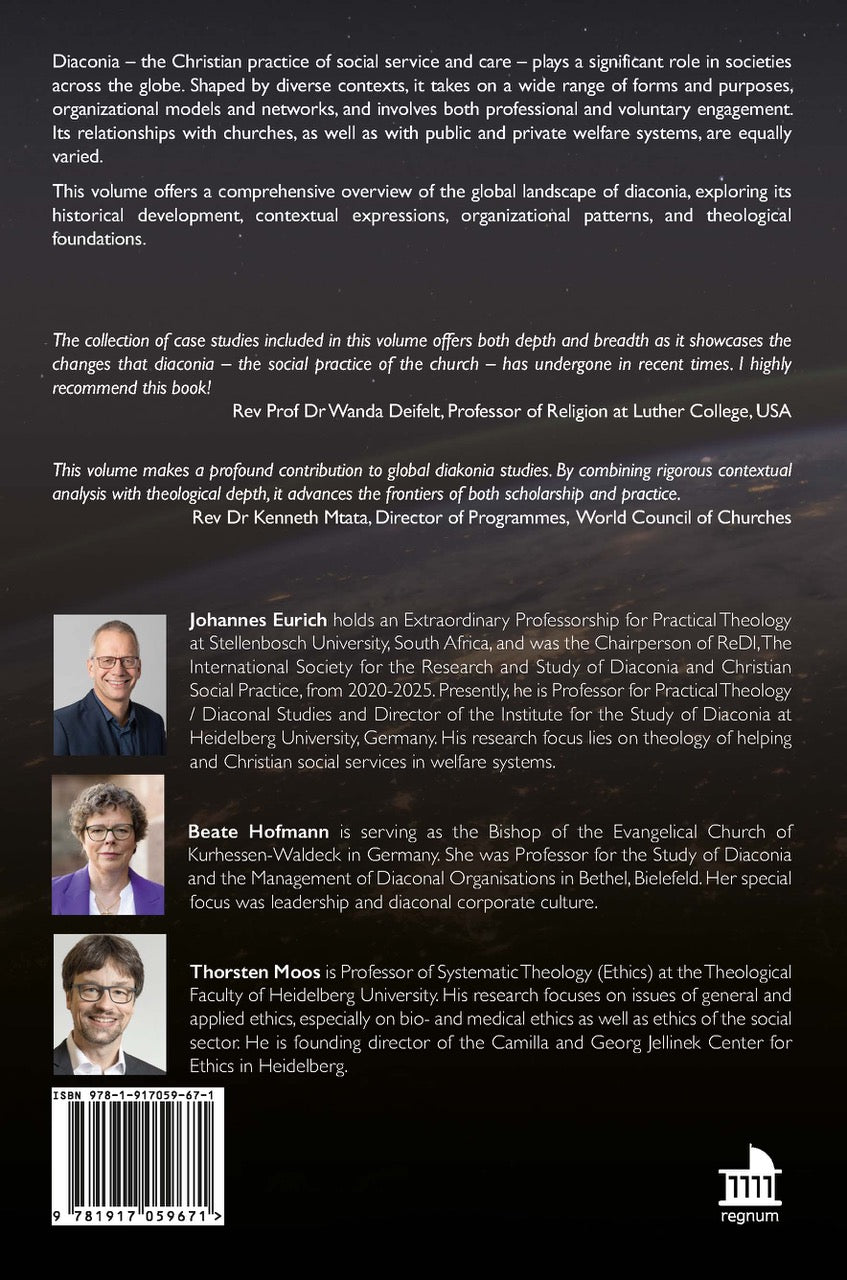
Diaconia – the Christian practice of social service and care – plays a significant role in societies across the globe. Shaped by diverse contexts, it takes on a wide range of forms and purposes, organizational models and networks, and involves both professional and voluntary engagement. Its relationships with churches, as well as with public and private welfare systems, are equally varied.
This volume offers a comprehensive overview of the global landscape of diaconia, exploring its historical development, contextual expressions, organizational patterns, and theological foundations.
The collection of case studies included in this volume offers both depth and breadth as it showcases the changes that diaconia – the social practice of the church – has undergone in recent times. Its breadth lies in the wide range of contexts represented: Argentina, Australia, Brazil, Burkina Faso, Colombia, Czech Republic, Ghana, Germany, India, Indonesia, Norway, Philippines, South Africa, South Korea, Sweden, Switzerland, Tanzania, and the United States. Each case study offers its own depth by addressing the structures and frame conditions of diaconal organizations, the societal and cultural background of diaconia in that particular context, how diaconia is engaged in societal transformation and, finally, the challenges and possibilities of diaconal theology as a scientific discipline. I highly recommend this book!
Rev Prof Dr Wanda Deifelt, Professor of Religion at Luther College, USA
This volume makes a profound contribution to global diakonia studies. By combining rigorous contextual analysis with theological depth, it advances the frontiers of both scholarship and practice.
Rev Dr Kenneth Mtata, Director of Programmes, World Council of Churches
In a world facing an increasing number of global crises the last decade has seen a renewed interest in Ahe social practice of the Christian churches, diakonia. This volume is a welcome and impressive ecumenical addition to a number of books published on what this practice might imply in various contexts globally. Empirical and theoretical contributions provide the reader with a rich ‘smorgasbord’ of perspectives, each deepening our understanding on a phenomenon that may only be understood contextually.
Professor Emerita, Rev Dr Ninna Edgardh, former Chair of The International Society for Research and Study of Diaconia and Christian Social Practice (REDI)
Table of Contents
Table of Contents
CONTENTS
Foreword by Rev. Heather Roy, Eurodiaconia ix
Foreword by Rev. Godwin G.D. Ampony, United Evangelical Mission xi
1. Introduction
Johannes Eurich, Beate Hofmann and Thorsten Moos 1
2. Diaconia and Sustainable Peace: Paradigms and Challenges
for Latin America
Humberto Shikiya and Milton Mejia 13
3. The Function of Theology in Faith-Based Agencies:
A Post-Colonial Perspective from Australia
John G. Flett 35
4. Diaconia in a Fragile State: An Example from Brazil
Rodolfo Gaede Neto and Helio Aparecido Teixeira 55
5. Diaconia and Christian Witness: Experiences from West Africa
Ini Dorcas Dah and Sylvia Owusu-Ansah 73
6. Personal Salvation and Social Service: Diaconia in China
Ji Zhang and Baoping Kan 83
7. To Build Bridges and To Leaven the Dough: Caritas and Diaconia in the Perspective of the Radically Secular Czech Experience
Michal Opatrný and Karel Šimr 103
Cross-Perspective I: Changes in the Religious Field
Karel Šimr and Michal Opatrný 131
8. From Inner Mission to Social Professions: Diaconia in Germany between Church and Welfare State
Johannes Eurich, Beate Hofmann and Thorsten Moos 143
9. Diaconia in Praxis: Concepts and Culture of Social Services in the Perspective of the Church of North India
Pradeep K. Samantaroy and Pratap C. Gine 183
Cross-Perspective II: Diaconia and Culture
Helio A. Teixeira 209
10. Transforming Community through Interfaith Diaconia in the
Indonesian Context
Jozef Mepibozef Nelsun Hehanussa 215
11. Diaconia as Christian Social Practice: Nordic Approaches to
Diaconal Studies
Annette Leis-Peters and Martha Middlemiss Le Mon 237
12. Diaconia as Peacebuilding: A Case in the Philippines
Wendy Kroeker and Dennis T. Solon 281
13. Meeting the Legacy of Poverty and Inequality? Diaconal Responses in South Africa in Historical and Contemporary Perspective
Ignatius Swart and Nadine Bowers Du Toit 307
Cross-Perspective III: Transformational Diaconia
Nadine Bowers du Toit 345
14. The Concept and Development of Diaconia in Korea:
Interaction and Tension between Diaconia and Social Welfare
Sunghyun Oh and Sunghui Cho 351
15. Social Work and Diaconal Science in a Rich Country of Western Europe: Diaconia in Switzerland
Dörte Gebhard and Christoph Sigrist 389
Cross-Perspective IV: Diaconal Education
Annette Leis-Peters 415
16. An African Perspective on Diaconia: Reflections from the
Evangelical Lutheran Church in Tanzania
Hoyce Jacob Lyimo-Mbowe 427
17. The Transfer of Diaconia from Germany to North America:
The Diaconate and Lutheran Social Services in the United States
Craig L. Nessan 445
Contributors 465
Subject Index 469
Name Index 475
About the Author
About the Author
ABOUT THE EDITORS:
Johannes Eurich holds an extraordinary professorship for Practical Theology at Stellenbosch University, South Africa, and was the chairperson of ReDI, The International Society for the Research and Study of Diaconia and Christian Social Practice, from 2020-2025. Presently, he is professor for Practical Theology / Diaconal Studies and director of the institute for the study of Diaconia at Heidelberg University, Germany. His research focus lies on theology of helping and Christian social services in welfare systems.
Beate Hofmann is serving as the bishop of the Evangelical Church of Kurhessen-Waldeck in Germany. She was professor for the study of diaconia and the management of diaconal organisations in Bethel, Bielefeld. Her special focus was leadership and diaconal corporate culture.
Thorsten Moos is professor for Systematic Theology (Ethics) at the Theological Faculty of Heidelberg University. His research focuses on issues of general and applied ethics, especially on bio- and medical ethics as well as ethics of the social sector. He is founding director of the Camilla and Georg Jellinek Center for Ethics in Heidelberg.
QUESTIONS TO THE EDITORS ABOUT THE BOOK:
1. Why did you decide to write your book?
We decided to edit this book in order to gain insights into diaconal work in different cultural backgrounds, political systems and religious contexts. We consider this book a must for teaching international students and to enrich the perspective of diaconia worldwide. To that aim, we invited authors from various contexts, each one an expert in his or her field. We worked together for several years to enhance mutual understanding.
2. What is distinctive about the content of your book?
Our book gives authentic perspectives on diaconia in different continents and contexts. More than that, it is unique in interweaving and linking different perspectives and experiences and in scrutinizing common themes and challenges of diaconal work around the globe.
3. Why is this subject important?
Many problems in our world will be solved only in global cooperations and collective learning. That presupposes mutual understanding. It is particularly inspiring to gain insider’s perspectives of how churches in very different circumstances manage to give a diaconal witness.
4. What difference would this book make for the ministry?
Diaconia is the social face of the church in demanding times. To understand how it is working and struggling in different contexts enriches our perspectives on diaconia and on our interconnectedness.
5. Feel free to add anything else you find relevant.
The book is an important resource for teaching and research on transformative diaconia in a global perspective.
Endorsements
Endorsements
Diaconia – the Christian practice of social service and care – plays a significant role in societies across the globe. Shaped by diverse contexts, it takes on a wide range of forms and purposes, organizational models and networks, and involves both professional and voluntary engagement. Its relationships with churches, as well as with public and private welfare systems, are equally varied.
This volume offers a comprehensive overview of the global landscape of diaconia, exploring its historical development, contextual expressions, organizational patterns, and theological foundations.
The collection of case studies included in this volume offers both depth and breadth as it showcases the changes that diaconia – the social practice of the church – has undergone in recent times. Its breadth lies in the wide range of contexts represented: Argentina, Australia, Brazil, Burkina Faso, Colombia, Czech Republic, Ghana, Germany, India, Indonesia, Norway, Philippines, South Africa, South Korea, Sweden, Switzerland, Tanzania, and the United States. Each case study offers its own depth by addressing the structures and frame conditions of diaconal organizations, the societal and cultural background of diaconia in that particular context, how diaconia is engaged in societal transformation and, finally, the challenges and possibilities of diaconal theology as a scientific discipline. I highly recommend this book!
Rev Prof Dr Wanda Deifelt, Professor of Religion at Luther College, USA
This volume makes a profound contribution to global diakonia studies. By combining rigorous contextual analysis with theological depth, it advances the frontiers of both scholarship and practice.
Rev Dr Kenneth Mtata, Director of Programmes, World Council of Churches
In a world facing an increasing number of global crises the last decade has seen a renewed interest in Ahe social practice of the Christian churches, diakonia. This volume is a welcome and impressive ecumenical addition to a number of books published on what this practice might imply in various contexts globally. Empirical and theoretical contributions provide the reader with a rich ‘smorgasbord’ of perspectives, each deepening our understanding on a phenomenon that may only be understood contextually.
Professor Emerita, Rev Dr Ninna Edgardh, former Chair of The International Society for Research and Study of Diaconia and Christian Social Practice (REDI)
Additional Resources and Book Reviews
Additional Resources and Book Reviews
Share