

Contemporary Arabic Christian Theology
Contemporary Arabic Christian Theology
Najib George Awad
2024 | 268pp pb | 978-1-917059-36-7
An Introduction to Its Identity, History, and Trends of Reasoning
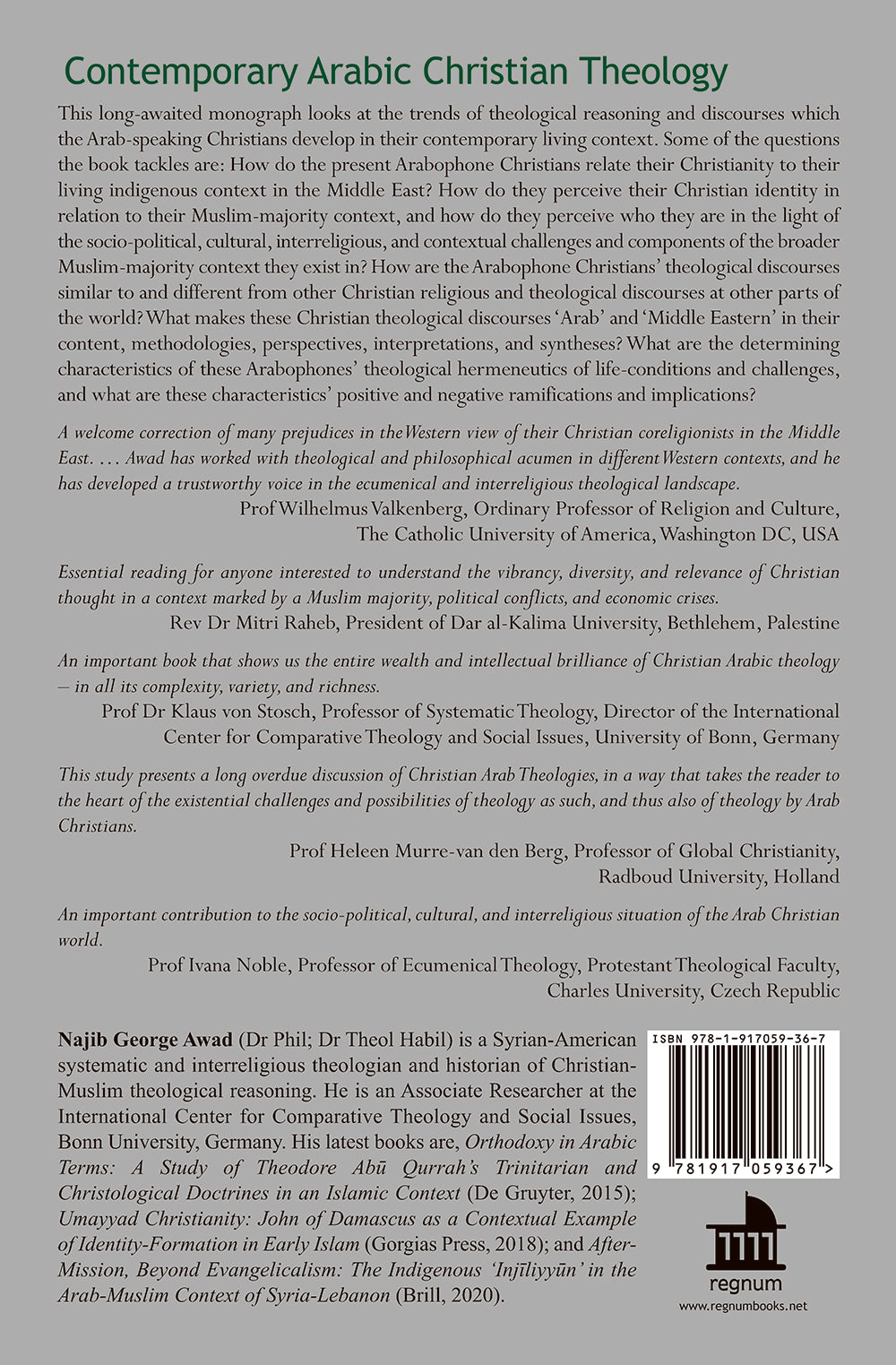
This long-awaited monograph looks at the trends of theological reasoning and discourses which the Arab-speaking Christians develop in their contemporary living context. Some of the questions the book tackles are: How do the present Arabophone Christians relate their Christianity to their living indigenous context in the Middle East? How do they perceive their Christian identity in relation to their Muslim-majority context, and how do they perceive who they are in the light of the socio-political, cultural, interreligious, and contextual challenges and components of the broader Muslim-majority context they exist in? How are the Arabophone Christians’ theological discourses similar to and different from other Christian religious and theological discourses at other parts of the world? What makes these Christian theological discourses ‘Arab’ and ‘Middle Eastern’ in their content, methodologies, perspectives, interpretations, and syntheses? What are the determining characteristics of these Arabophones’ theological hermeneutics of life-conditions and challenges, and what are these characteristics’ positive and negative ramifications and implications?
Table of Contents
Table of Contents
CONTENTS
Introduction 1
1 Clearing the Conceptual Ground 11
Introduction: ‘Arab Christianity’? 11
Arab Christianity as Ecclesial Community 12
Arab Christianity as Christian Personnel 14
Arab Christianity as an Expression of a Linguistic Entity 19
Arab Christianity as a Nomenclature of a Particular ‘Tradition’ 21
2 Arab Christian Tradition, Past and Present 27
Introduction 27
The Birth of a Legacy 27
The Beginning of Decline 33
Diving Down and Climbing Up the Abyss 36
Surviving Today 42
3 Arab Christian Theological Tradition in Western Scholarship 47
Introduction 47
The Degrading Orientalist Appraisal 49
The Targeting and Essentialising Orientalist Trend 54
Arabic-Eastern Christianity in Today’s Western Imagination 72
Concluding Remarks 76
4 Arab-Eastern Christian Theology, Past and Present 79
Introduction 79
Arabic-Speaking Eastern Theology in the Past 79
Arabic-Speaking Eastern Theology in the Present 90
5 Main Contemporary Trends of Arab-Eastern Theologies 93
Introduction 93
Liberationist Arab-Eastern Theology 96
Contextualised Arab-Eastern Theology 109
Land-Based Arab-Eastern Theology 122
Protectionist and Self-Enclosed Arab-Eastern Theology 129
Culture-Centred Arab-Eastern Theology 135
Interreligious Arab-Eastern Theology 148
Interrelational Arab-Eastern Theology 163
Woman-Centred Arab-Eastern Theology 176
6 Arab-Eastern Theology:
Characteristics and Potential Revisions 199
Concluding Remarks 221
Bibliography 235
About the Author
About the Author
ABOUT THE AUTHOR:
Najib George Awad (Dr. Phil; Dr. Theol. Habil): an Arab-American (originally from Syria) Systematic, inter-religious and Comparative theologian and historian of religious thought, an author and a poet. He is an Associate Research at the Center for Comparative Theology and Social issues (CTSI), Bonn University, Germany. He is also the former Professor of Christian Theology and Eastern Christian Thought and the Director of the PhD Program in Islamic Studies and Christian-Muslim Relations in Hartford Seminary, Connecticut USA. He had his first PhD from King’s College University of London, UK (2007) and his second Dr. Theol. Habil. from the Philipp University of Marburg, Germany (2014). His other monographs in English are, God without Face? On the Personal Individuation of the Holy Spirit (Mohr Siebeck, 2011); And Freedom Became a Public-Square: Political, Sociological and Religious Overviews on the Arab Christians and the Arabic Spring (LIT Verlag, 2012); Persons in Relation: An Essay on the Trinity and Ontology (Fortress Press, 2014); and Orthodoxy in Arabic Terms: A Study of Theodore Abū Qurrah’s Trinitarian and Christological Doctrines in an Islamic Context (De Gruyter, 2015); Umayyad Christianity: John of Damascus as a Contextual Example of Identity-Formation in Early Islam (Gorgias Press, 2018); and After-Mission, Beyond Evangelicalism: The Indigenous ‘Injīliyyūn’ in the Arab-Muslim Context of Syria-Lebanon (Brill, 2020). He is working right now on a research project on Mu’tazilite and Christian Kalām in the 3rd/9th century Abbasid era.
QUESTIONS TO THE AUTHOR ABOUT THE BOOK:
1. Why did you decide to write your book?
Throughout the past years, many colleagues and friends in academia asked me to name for them texts touch upon the theological reasoning in the contemporary Arab Middle East. I failed to find any text on this subject to name for them. So, I decided to avail such a text in English for the Western academic reader.
2. What is distinctive about content of your book?
There is a vast literature on the Christian Arab-Eastern thought available today in foreign languages in the academic libraries today. Yet, there is not yet any fully-fledged book on the Christian Arabic theological reasoning in today’s Middle East. The Western academic world has also developed massive amount of texts on contemporary Arabic and non-Arabic Islam in that region. My book’s uniqueness lies in the fact that it introduces the Western readership to the contemporary Christian theological trends of reasoning that has been produced, and is only available, in Arabic language. So, the book uniquely and unprecedently offers an access to a theology that is being written in a language that is not as accessible to so many western theological scholars, students and readership.
3. Why is this subject important?
It is essential to construct knowledge and raise scientific reliable awareness of the various non-Western Christian theological trends and discourses that are developed by the Christians around the world, or the Global South. My book is one of these literatures that study this subject by focusing on the particular context of the Arab-Eastern Christian traditions that exist today in the Arab World.
4. What difference would this book make for the ministry?
Almost every ecclesial tradition in today’s Western world contains members, affiliates, and regular attendants who are immigrants or refuges hailing from Middle Eastern or Arab background. This book would be an excellent educating tool for these churches’ ministers to enable them to develop knowledge of some of the crucial and central issues which these immigrants and refugees used to be occupied with, or their homeland churches were focusing on, in the Christian context back in their native lands. This will enable these ministers to sharpen their pastoral, context-sensitive, pluralist, and pedagogical skills and sensitivity as they prepare church services to such a pluralist membership.
Endorsements
Endorsements
This book about Contemporary Arab Christian Theology by Najib George Awad is a welcome correction of many prejudices in the Western view of their Christian coreligionists in the Middle East. We have a long history of not taking the theological contributions of our Christian brothers and sisters seriously. A theologian from Syria, Awad has worked with theological and philosophical acumen in different Western contexts, and he has developed a trustworthy voice in the ecumenical and interreligious theological landscape.
Prof. Wilhelmus Valkenberg, Ordinary Professor of Religion and Culture, The Catholic University of America, Washington DC, USA
Contemporary Arab Christian Theology is an in-depth and comprehensive study of the intellectual production of Arab-speaking Christian theologians in the Middle East in the last four decades. Najib Awad’s book is an essential reading for anyone interested to understand the vibrancy, diversity, and relevance of Christian thought in a context marked by a Muslim majority, political conflicts, and economic crises.
Rev. Dr. Mitri Raheb, President of Dar al-Kalima University,
Bethlehem, Palestine
An important book that shows us the entire wealth and intellectual brilliance of Christian Arabic theology – in all its complexity, variety, and richness.
Prof. Dr. Klaus von Stosch, Professor of Systematic Theology, Director of the International Center for Comparative Theology and Social Issues, University of Bonn, Germany
This study from Najib George Awad presents a long overdue discussion of Christian Arab Theologies, in a way that takes the reader to the heart of the existential challenges and possibilities of theology as such, and thus also of theology by Arab Christians. Despite growing attention to Christians in and from the Middle East, their theologies have only superficially been engaged with. Language barriers may have played a role here, though also Western preoccupation with the socio-political position of these Christians might have prevented a closer look at their creative contribution to theology, in the past and the present. Awad convincingly shows that it is the loss of Christian theology if we continue to ignore this.
Prof. Heleen Murre-van den Berg, professor of Global Christianity, Radboud University, Holland
This timely volume offers a Western audience an encounter with the muchneglected world of Arab Eastern Christians, whose voices both preceded and accompanied those of the Islamic majority of the territories of Syria, Lebanon, Iraq, Palestine, Jordan and Egypt. Opening up to the reader the complex history of these Christian communities, it depicts their theological heritage, as well as their theological reflection on contemporary struggles. The book seeks for a liberative potential through a hermeneutics of present life conditions, in conversation with the specific spiritual and intellectual legacy of Arab Eastern Christians who have lived in proximity with Islam for centuries. The book, written by someone from that context, makes an important contribution to the socio-political, cultural, and interreligious situation of the Arab Christian world, and allows non-Arabic speakers access to a wealthy textual tradition.
Prof. Ivana Noble, Professor of Ecumenical Theology, Protestant Theological Faculty, Charles University, Czech Republic
Arab Christians have been an important part of the world Christian movement since the first day of Pentecost. Yet, today, most Western Christians continue to assume that all Arabs are Muslim. In the last thirty years there has been a great deal of Western scholarly activity engaging medieval Arab Christian theology, examining the indigenous Arab Christian theological discourse in response to Islam. Yet, there is an almost complete lack of Western interest in contemporary Arab theological thought and discourse. Of course, one reason for this lacuna is due to language. Few Western theologians have Arabic language skills, and few Arab theologians regularly write for Western audiences. In this landmark study, George Najib Awad provides a much-needed introduction to the lively and vibrant Arab Christian “reasoning and discourse” from within. Arab Christian theological reflection does need to be recognized for its ongoing creativity and does need to be included in surveys of contemporary World Christianity. We can thank Professor Awad for this important groundbreaking contribution.
Rev. Prof. David D. Grafton, Professor of Islamic Studies and Christian-Muslim Relations, Director of the Duncan Black Macdonald Center, Hartford International University, CT USA
Additional Resources and Book Reviews
Additional Resources and Book Reviews
Share