

Atonement Theology in Conversation with Islamic Thought
Atonement Theology in Conversation with Islamic Thought
Brent Neely
2024 | 264pp pb | ISBN: 978-1-917059-16-9
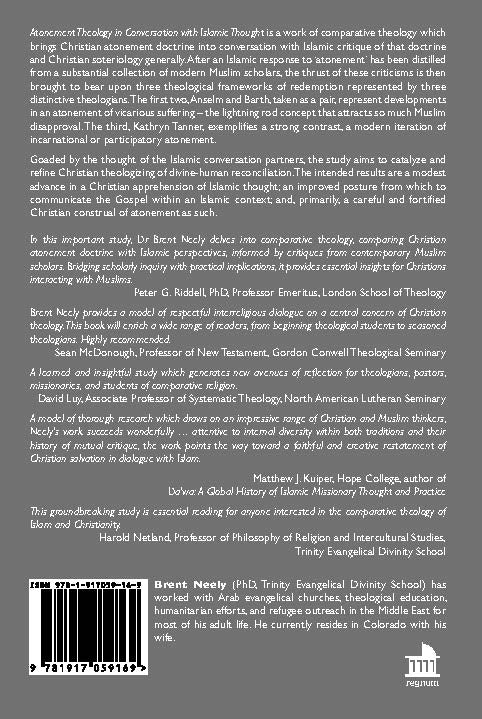
Atonement Theology in Conversation with Islamic Thought is a work of comparative theology which brings Christian atonement doctrine into conversation with Islamic critique of that doctrine and Christian soteriology generally. After an Islamic response to ‘atonement’ has been distilled from a substantial collection of modern Muslim scholars, the thrust of these criticisms is then brought to bear upon three theological frameworks of redemption represented by three distinctive theologians. The first two, Anselm and Barth, taken as a pair, represent developments in an atonement of vicarious suffering – the lightning rod concept that attracts so much Muslim disapproval. The third, Kathryn Tanner, exemplifies a strong contrast, a modern iteration of incarnational or participatory atonement.
Goaded by the thought of the Islamic conversation partners, the study aims to catalyze and refine Christian theologizing of divine-human reconciliation. The intended results are a modest advance in a Christian apprehension of Islamic thought; an improved posture from which to communicate the Gospel within an Islamic context; and, primarily, a careful and fortified Christian construal of atonement as such.
Table of Contents
Table of Contents
CONTENTS
Acknowledgements....................................................... xiii
Abbreviations ................................................................ xv
1. Introduction ............................................................... 1
The Context of This Study 1
A Work of Theology and Comparative Theology 2
The Purpose and Ethos of This Conversation 3
The Shape of the Discussion 4
Three Motifs 4
Three Schools of Atonement Thought 5
Where Do We Land? 7
A Word on Comparative Theology 8
2. Christian Atonement Thought .................................... 11
Mapping Atonement 11
Model, Metaphor, Mystery 12
From Images to Theories 12
Diverse Images and Models of Atonement 13
Mystery and Paradox 13
The Development of Atonement Doctrine 14
Ransom Theory and Polyvalence in Patristic Salvation 15
The Breadth of Atonement Concepts in Scripture and Tradition 16
Objective, Subjective, and Other Atonements 17
Exemplarism 17
Objective and Subjective Views: The Necessity of the Cross 18
Vicarious Suffering: Sacrifice and Wrath 19
Penal Substitution 19
The Cross, Ethics, and Time in Divine and Human Perspective 20
Incarnational or Participatory Atonement 22
Composite Approaches: Commending Integration 23
The Task at Hand 24
3. Islamic Theologizing of Salvation ............................. 25
Islamic Response to Atonement Theory 25
A Collection of Modern Muslim Writers 26
Islamic Soteriology 26
Just Judgment by Works 27
Fitra and Original Sin 28
Sin-Awareness in Islam 28
Salvation in Gnosis 29
Law and Obedience, Not Atonement 29
Forgiveness: Repentance and Realism, not “Saviorism” 31
Intercession 32
Faith and Works 32
The Mystery of Predestination: Qadar 33
The Path to Paradise 34
4. Muslim Theologians on Atonement ........................... 35
Mapping the Chapter 35
An Aside on Aesthetics 36
Original Sin 36
Justice Critique of Substitutionary Atonement 38
Objections to Cultic Mediation 38
“Justice from Above”:
Atonement’s Failures in Reason and Justice 40
“Justice from Below”:
Irrationalism Correlates with Moral Dereliction 41
Atonement Theology Generates a Deficient Social Ethic 42
God’s Honor: Atonement as Violation of Divine Transcendence 44
Vicarious Mediation: Pagan Immanentizing 45
Muzzling Divine Power? 46
God’s Honor and Metaphysical Intuition 48
The Contradictions of Biblical Salvation-History 50
Conclusion 52
Sin 53
Justice 53
Honor and Transcendence 54
5. Anselmian Atonement .............................................. 57
Mapping This Chapter 57
The Anselmian Coterie 58
Situating Anselm after the Fathers 59
Cur Deus Homo 59
Debt and Honor Satisfaction vs Guilt and Substitutionary Punishment 61
Modern Problems with Anselm 62
Contextualizing Anselm for Our Day 62
Translating from His Theological Location to Ours 63
The Utility of a Narrow Focus 63
CDH: Metaphysics and Doxology 63
On Justice 64
A Fissure between Justice and Mercy? 64
Justice and Satisfaction 66
Satisfaction and Justice: The Gift of Excess Merit 68
Satisfaction: No Impunity, Rather Restoration 69
Contextualizing Satisfaction for Today 70
On Honor 71
Honor, Justice, and Restoration 73
The Convergence of Divine Honor and Human Good 73
Honor and Necessity 74
Necessity: Arbitrary or Fitting? 75
Necessity Does Not Invalidate Grace 76
Contextualizing Honor 76
The Sin Question 77
Sin as Debt, Sin as Universal 77
Sin’s Gravity 78
Concluding Thoughts on Anselm and CDH 79
6. Barth and Substitutionary Atonement ........................ 81
Mapping the Discussion 81
From Anselm to Calvin and PSA 81
PSA and Other Redemption Models 82
Western and Islamic Issues with PSA 83
Barth and Friends on Substitutionary Atonement 84
Barth’s Atonement, Vicarious and “Objective” 85
Justice “from Below”: God, Substitution, and Humanity 86
Wrath and Love 86
Wrath and Penalty 87
Penalty Affirmed and Decentered 89
Justice and the Metaphysics of Exchange 89
Substitution and Representation 91
The “Exchange” of PSA: A Metaphysical Participation 91
“Objective” Atonement: Who is Changed? 92
The Metaphysics of Exchange: Ethics and Discipleship 93
Justice and Resurrection 94
Excursus: Christ Alone? 95
Justice “from Above”: Atonement and Trinity 98
Trinity Enables Redemption 98
Trinitarian Unity Disciplines PSA: No Vengeance of Father on Son 98
Inseparable Action: Love, Wrath, and Causality 100
Sin in Barth’s Atonement Thought 100
Original Sin, Holy Fear, and Hope 102
The Enormity of Sloth 104
Divine Honor I: God in Salvation History 105
God’s Freedom and the “Necessity” of the Cross 106
God’s Honor and the Strangeness of Salvation’s Story 107
The Descent of the Son: God’s Honor or Shame? 108
The God-Man and Mystery 109
Divine Honor II: Loving Freely and Timelessly 110
Honor, Freedom, and Time 112
Divine Honor, Chronology of Salvation, and the
Human Predicament 113
Summing Up the Discussion 115
7. Tanner’s Participatory Atonement ............................. 117
Turning to Participatory and Incarnational Atonement 117
Introducing Kathryn Tanner 117
Tanner’s Atonement and Sin, Honor, and Justice 118
Christ the Key 119
Two Modes of Imaging, Two Natures of Christ 120
United with the Son: Non-penal Justification and the Return to God 121
Participation: A Call to Life in the Trinity 122
Trinitarian Monotheism 123
Decentering the Cross 124
The Metaphysics of Substitution or Representation 126
Participatory Atonement, Sacrifice, and Criticism of
Satisfaction and Penal Models 126
Sin and Human Moral Disposition 128
Grace, Sin, and Human Nature 129
Grace and Union with Christ:
A Restoration Exceeding Original Deficit 130
The Ethics of Participatory Atonement: The Sanctified Life 131
Christ (Not the “Social Trinity”):
The Pattern for Ethical Community 132
The Moral Shape of the Atoned Community 133
Justification and Sanctification 135
A Patient Leaning-in to Renewal 136
Preserving the Divine Transcendence 138
Transcendence and the Gratuity of Grace 140
Honoring God: Humility Before Divine Transcendence 141
Incarnation’s “Rough Texture”: A Threat to Divine Honor? 141
Incarnation Without Temporal Indexing 142
Stability in the Grace of a Timeless God 143
Tanner’s Incarnational Model: Concluding Thoughts 143
A Mild Critique 144
Participation and Justice 145
Participation and Honor 146
Participation, Sin, and Human Nature 146
8. Tying the Strands Together ..................................... 147
Synthesizing the Research 147
Contributions of Tanner and Participatory Thought 148
Tanner, Transcendence, and Honor 149
Tanner and Sin 149
Tanner on Justice and Holism 149
Integrating Islamic Critique and the Triple Themes 150
Sin 151
Sin: Original and Weighty 151
Ontological Redemption: The Implications for Allegedly
Sin-Obsessed Soteriology 152
Sin as Violation of Law 153
The Cross as the Prism for Sin 153
Justice 154
Justice from Above 154
Justice from Below 156
Objective and Subjective Together 156
Resurrection and Justice 158
Honor 159
The Cross as the Intersection of Incompatible Divine Perfections 159
God’s Honor in Timeless and Non-competitive Relations 160
Necessity as a Challenge to Divine Honor 161
Religious Aesthetics and Divine Honor: The Direction of
Travel in Incarnation 162
The “Risk” in Salvation 164
Transcendence Persists in Incarnation 165
Downward to Glory: Pondering What is Possible for God 166
Christoexclusivism and God’s Honor 168
Reaffirming Transcendence 169
Penultimate Issues: Atonement in Comparative Perspective 170
Coordinating Confessionally Contested Salvations:
My Christian Perspective 171
Sidebar on Sin: Spotlight on a Zone of Shared Concern 172
The Legal Lacuna and the Law of Christ 173
Metaphysics and Mystery 174
Conclusion: A Call to Integrative Atonement 175
Bibliography ................................................................. 179
Christian Theology Sources 179
Islamic and Islam-related Sources 189
Appendix A: Considering Comparative Theology ....... 199
Appendix B:
Brief Notice on Atonements of Liberation and Non- Violence ......... 203
Liberation Models 203
Non-Violent Atonement 204
Appropriating and Critiquing Non-Violent Proposals 205
Appendix C: On Islamic Authors ................................. 207
Appendix D: Muslim Authors Receptive to “Atonement”
– An Aside on Paths Not Taken ................................... 209
Appendix E: Hart’s Summary of CDH ........................... 211
About the Author
About the Author
ABOUT THE AUTHOR:
Brent Neely (PhD 2022, Trinity Evangelical Divinity School) has worked with Arab evangelical churches, theological education, humanitarian efforts, and refugee outreach in the Middle East for most of his adult life. He currently resides in Colorado with his wife.
QUESTIONS TO THE AUTHOR ABOUT THE BOOK:
1. Why did you decide to write your book?
In the book I insist that the category “salvation” encompasses more than simply the Passion of Christ. Nonetheless, the cross and resurrection are rightly positioned as redemption’s singularity, as the “super-heated core” of atonement. And I have long found the mystery, the drama, the loss and the victory of the cross to be a persuasive paradox. It is a conundrum beyond my explanatory powers and yet one that fittingly and powerfully speaks to both the degradation and potential of the human condition. These impulses imperceptibly, over time, fed the processes that led to my study.
Another background influence which spurred the eventual writing of this book was that of culture and location—namely, years of life in the Middle East. This is a region that I so love; that I find intensely compelling; and the hurts and trauma of which have scarred so many. Precisely here, it seems to me, the cross and resurrection speak with painful realism and powerful hope. Further, I lived in a context in which Christianity was demographically dwarfed by the other monotheistic blocs of Judaism and Islam. And, in different ways, for both religious communities the cross represents a seemingly insuperable stumbling block; meanwhile, I was ever more convinced that the suffering and reigning Christ speaks with precisely calibrated love, power, hope, and relevance to all the communities of that region.
In any case, these were the underlying experiences and convictions that informed my choice to pursue the sort of project I did when the opportunity arose for me to write a dissertation in comparative theology. Ultimately, those efforts eventuated in this book.
2. What is distinctive about the content of your book?
The idea of comparative theological work between Christianity and Islam is, of course, not new. But there are some distinctive aspects to this foray into comparative theology. I would begin by highlighting my good faith effort to allow Islamic discourse to provide an external “prod” to an important, ongoing, and contested Christian conversation on atonement (understood here as a comprehensive salvation construct). Systematic theological questions are usually explored alongside key implicit or explicit conversation partners, for example, the realms of philosophy, Marxism, feminism, and so on. In this case, Islam provides the leading foil. Along with all of this, I have chosen some important and incisive Christian theologians (Anselm, Barth, Tanner) to headline the conversation, in company with many other generative thinkers. Bringing this particular collection of thinkers and inter-religious ideas into contact flavors the study in a distinct way. Finally, I hope that readers will find the themes or organizing categories that emerged from the Islamic critique (justice, honor, and sin-and-human-nature) helpful.
3. Why is this subject important?
First, atonement (taken as a broad-spectrum framing of salvation or redemption) is inarguably vital to Christian faith. Though qualifications might be offered, it is quite common to construe Christianity as a “salvation religion” or “redemption faith.” Atonement, commonly centered on the work of the cross, is front-and-center in Christianity. But part of the reason that atonement theology fills endless volumes and generates ongoing debate is that there is no detailed ecumenical definition describing salvation in precise terms and laying out exactly how it “works.” (Consider the plethora of competing models, theories, and proposals.) Evidently, atonement is important in technical theological writing, not to mention in the hearts and souls of men and women seeking forgiveness, freedom, or renewal.
Secondly, in the theological interface between Christian and Islamic monotheisms, concepts of salvation and atonement are frequently and hotly contested. Theological tremors sometimes emanate from this dialogue, and their epicenter is often “the cross” and its disputed significance. To oversimplify, that which is definitive for the one faith is commonly seen as anathema to the other. When the topic is the two largest world religions’ construal of “salvation,” that intersection is bound to be of considerable importance.
4. What difference would this book make for the ministry?
In terms of ministry, two desired impacts come to mind. First, as this book is in part an exercise in listening to Islamic thought, charges, and arguments, I hope that it may help the reader to better consider and understand Islamic convictions and assumptions, especially in their engagement with Christian faith and soteriology. In one sense, this is simply a matter of enacting the Golden Rule, of treating others as we wish to be treated. The resulting fortified understanding, on the part of Christians, will only be to the good as they operate cross-culturally in spaces inflected by Islamic influence.
Second, I hope that this exercise in theologically grappling with the promise, mystery, and conundrums of atonement will deepen our comprehension of what the Father has done in redeeming creation in Christ and the Spirit. A key catalyst in this project is the queries and challenges emerging from Islamic thinkers. The point in listening to these interlocutors is not mere appeasement or capitulation. The point, rather, is humble reflection so that—being driven back to Scripture and tradition—we might better understand “the height and depth” of atonement. If this is achieved, even a little, that can only be to the benefit of Christian ministry.
Endorsements
Endorsements
In this important study, Dr Brent Neely delves into comparative theology, comparing Christian atonement doctrine with Islamic perspectives, informed by critiques from contemporary Muslim scholars. Assessing three redemption frameworks in response to Islamic critiques centered on divine justice, honor, and sin, the study seeks to deepen Christian comprehension of Islamic thought, inform Gospel communication in Islamic settings, and, primarily, refine Christian perspectives on atonement by integrating incarnational and trinitarian
emphases. Bridging scholarly inquiry with practical implications, it provides essential insights for Christians interacting with Muslims.
Peter G Riddell, PhD, Professor Emeritus, London School of Theology
In Atonement Theology in Conversation with Islamic Thought, Brent Neely provides a model of respectful interreligious dialogue on a central concern of
Christian theology. Rather than seeking a lowest-common denominator solution that leaves no one happy, he listens carefully to his Islamic interlocutors and gives a reasoned response affirming the integrity of Christian perspectives on the atonement. Drawing on major Christian thinkers, he articulates the significance of Christ’s death on the cross with clarity, sensitivity and appropriate nuance.
This book will enrich a wide range of readers, from beginning theological students to seasoned theologians. Highly recommended.
Sean McDonough, Professor of New Testament,
Gordon Conwell Theological Seminary
It is a noticeable pattern of church history that growth in theological wisdom is often catalyzed by sustained engagement with non-Christian religious traditions.
In this book, Brent Neely undertakes the somewhat daunting yet exceedingly fruitful task of placing contemporary Christian theologies of atonement into
conversation with Islamic soteriology. The result of the encounter is a learned and insightful study which generates new avenues of reflection for theologians,
pastors, missionaries, and students of comparative religion.
David Luy, Associate Professor of Systematic Theology,
North American Lutheran Seminary
In this timely study, Brent Neely provides a path-breaking account of Christian salvation in conversation with Islamic thought. The world’s second largest and fastest-growing religion, Islam has been an interlocutor of Christian thought for 14 centuries, but rarely have Christian thinkers seriously grappled with the ways
Christian understandings of soteriology might be refined or more carefully communicated in light of Islamic soteriologies. A model of thorough research which draws on an impressive range of Christian and Muslim thinkers, Neely’s work succeeds wonderfully in doing just that. Attentive to internal diversity within both traditions and their history of mutual critique, the work points the way toward a faithful and creative restatement of Christian salvation in dialogue with Islam.
Matthew J. Kuiper, Hope College, author of Da'wa: A Global History of Islamic Missionary Thought and Practice (Edinburgh University Press)
Due to their very different theological commitments on sin and salvation, the death of Jesus Christ on the cross has long been a point of contention between Muslims and Christians. In this meticulously researched and thoughtful work, Dr Neely brings the critiques of atonement theory by some leading Muslim thinkers into serious conversation with the views of influential Christian
theologians, resulting in a creative exploration of a central Christian doctrine. Dr Neely is among the few theologians with the requisite skills to unpack both
Muslim and Christian perspectives on soteriology. This groundbreaking study is essential reading for anyone interested in the comparative theology of Islam and Christianity.
Harold Netland, Professor of Philosophy of Religion and Intercultural Studies, Trinity Evangelical Divinity School
Additional Resources and Book Reviews
Additional Resources and Book Reviews
Share