
Microfinance in Sub-Saharan Africa
Irene Banda Mutalima
Responding to the Voices of Poor People
2022 | 90pp pb | ISBN: 9781914454516
This work is licensed under a Creative Commons Attribution-NonCommercial-NoDerivatives 4.0 International License.
The licence details can be downloaded here: https://creativecommons.org/choose/
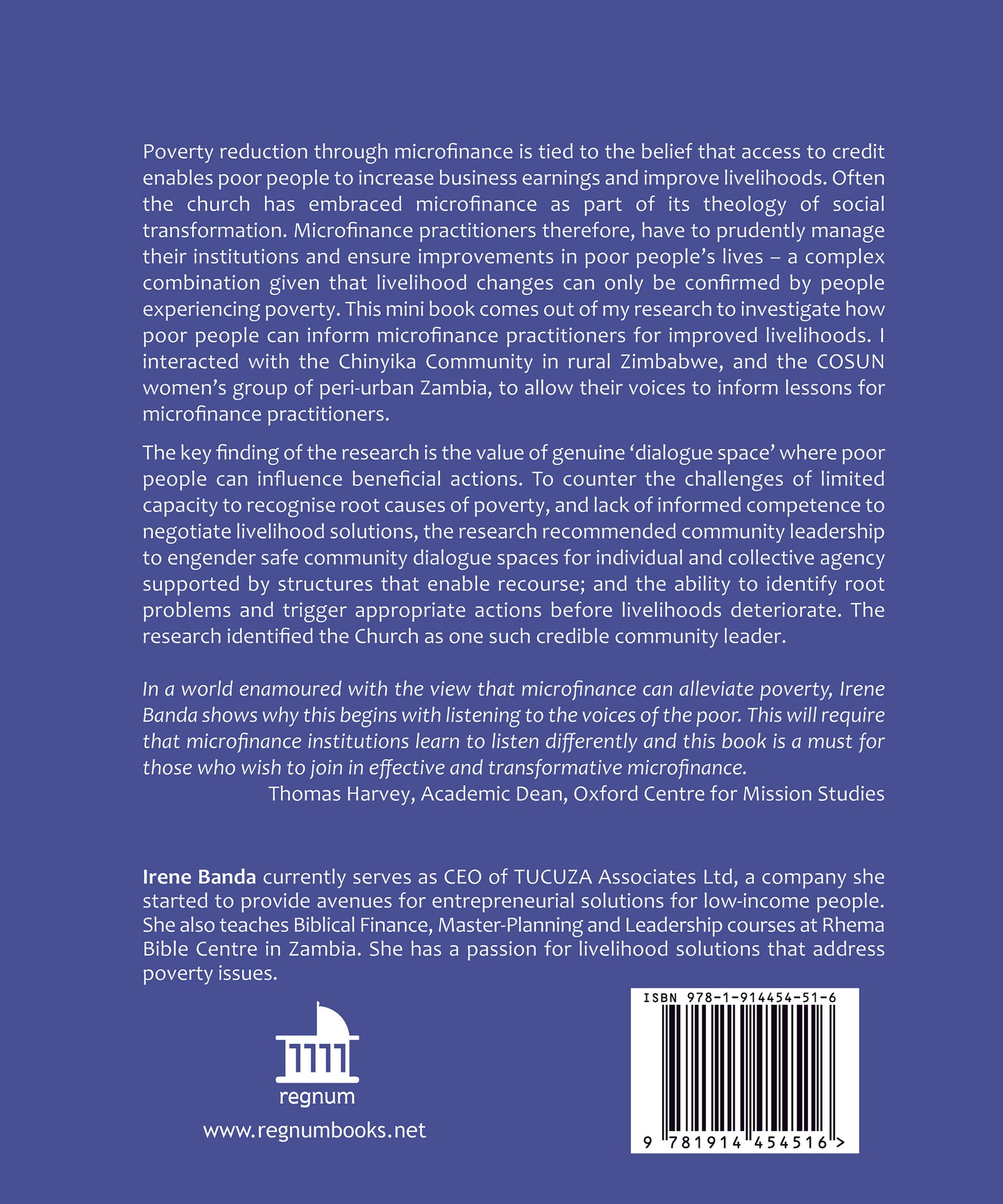
Poverty reduction through microfinance is tied to the belief that access to credit enables poor people to increase business earnings and improve livelihoods. Often the church has embraced microfinance as part of its theology of social transformation. Microfinance practitioners therefore, have to prudently manage their institutions and ensure improvements in poor people’s lives – a complex combination given that livelihood changes can only be confirmed by people experiencing poverty. This mini book comes out of my research to investigate how poor people can inform microfinance practitioners for improved livelihoods. I interacted with the Chinyika Community in rural Zimbabwe, and the COSUN women’s group of peri-urban Zambia, to allow their voices to inform lessons for microfinance practitioners.
The key finding of the research is the value of genuine ‘dialogue space’ where poor people can influence beneficial actions. To counter the challenges of limited capacity to recognise root causes of poverty, and lack of informed competence to negotiate livelihood solutions, the research recommended community leadership to engender safe community dialogue spaces for individual and collective agency supported by structures that enable recourse; and the ability to identify root problems and trigger appropriate actions before livelihoods deteriorate. The research identified the Church as one such credible community leader.
Table of Contents
Table of Contents
CONTENTS
Abbreviations vii
We are Strong, but... Women Working for Food 1
Research Structure 11
“Returning to Our Roots” 19
Comparing the COSUN Women and the Chinyika Women 31
COSUN Women Informing a Loan Process 43
A Summary of Research Findings 55
Responding to Poor People’s Voices 69
About the Author
About the Author
ABOUT THE AUTHOR:
Irene Banda (PhD) has a corporate background in retail banking and microfinance; she is a strategist and a financial services expert with a passion for transformative solutions, and a bias toward wealth creation and poverty reduction solutions. Irene served as Global Executive Director of ECLOF International under the World Council of Churches, based in Geneva; and as Africa Regional Director for Opportunity International, a global network of Christian microfinance institutions. She founded TUCUZA Associates currently developing a model for working with smallholder farmers to enhance production for local and export markets; and FINCUZA Institute a training entity with a focus on financial inclusion. Her action research PhD was among poor urban and rural women in Zambia and Zimbabwe to learn how responding to their voices can inform sustainable development initiatives.
QUESTIONS TO THE AUTHOR ABOUT THE BOOK:
1. Why did you decide to write your book?
This book is part of my PhD research that aims to listen and respond to poor people’s voices in microfinance. I had been a microfinance practitioner working in Christian environments and still grappling with the issues of responding appropriately to the poor people we served. The research allowed me to interact with one community in rural Zimbabwe and one community in peri-urban Zambia. This book contains the voices of the people I interacted with, how I responded to those voices and some of the lessons I learnt. I also draw out recommendations for microfinance institutions and Christian organisations serving poor people. That is the essence of the book.
2. What is distinctive about content of your book?
The important contents of the book are the unadulterated richness of the voices of mostly the women I interacted with. The voices have depth and meaning; they cry out for their rightful place in their communities, and when these spaces are given, the voices thrive. Where these voices are thwarted, they shrivel into painful whispers only heard among themselves. What is also distinctive is the recognition that when community spaces become responsive and safe, these voices can influence the desired change from collective engagement, thus opening the higher possibilities of more focused dialogue with organisations that provide services to improve livelihoods.
3. Why is this subject important?
This subject is important because so much resources have been poured into development initiatives that aim to reduce poverty, with Church congregations and Christian organisations taking part. Yet sustainable movements out of poverty have not been corresponded the efforts. Further, the efforts have tended to be externally driven, with the understandable but not justifiable reason that poor people often have reduced capacity to negotiate systemic challenges and therefore solutions out of poverty. This book aims to highlight the importance of creating dialogue spaces where people living in poverty can articulate their situations as they see them, and where their voices can be recognized to influence outcomes that benefit them.
4. What difference would this book make for the ministry?
This book would require those in ministry to introspect on how they create safe environments that recognize the importance of every voice- no matter their circumstances- and aim to respond to those voices appropriately. This book challenges those in ministry to really think about how they will engage and serve people living in poverty. It also provides tools for this level of engagements.
Endorsements
Endorsements
Poverty reduction through microfinance is tied to the belief that access to credit enables poor people to increase business earnings and improve livelihoods. Often the church has embraced microfinance as part of its theology of social transformation. Microfinance practitioners therefore, have to prudently manage their institutions and ensure improvements in poor people’s lives – a complex combination given that livelihood changes can only be confirmed by people experiencing poverty. This mini book comes out of my research to investigate how poor people can inform microfinance practitioners for improved livelihoods. I interacted with the Chinyika Community in rural Zimbabwe, and the COSUN women’s group of peri‐urban Zambia, to allow their voices to inform lessons for microfinance practitioners.
The key finding of the research is the value of genuine ‘dialogue space’ where poorpeople can influence beneficial actions. To counter the challenges of limited capacity to recognise root causes of poverty, and lack of informed competence to negotiate livelihood solutions, the research recommended community leadership to engender safe community dialogue spaces for individual and collective agency supported by structures that enable recourse; and the ability to identify root problems and trigger appropriate actions before livelihoods deteriorate. The research identified the Church as one such credible community leader.
In a world enamoured with the view that microfinance can alleviate poverty, Irene Banda shows why this begins with listening to the voices of the poor. This will require that microfinance institutions learn to listen differently and this book is a must for those who wish to join in effective and transformative microfinance.
Thomas Harvey, Academic Dean, Oxford Centre for Mission Studies
Additional Resources and Book Reviews
Share
