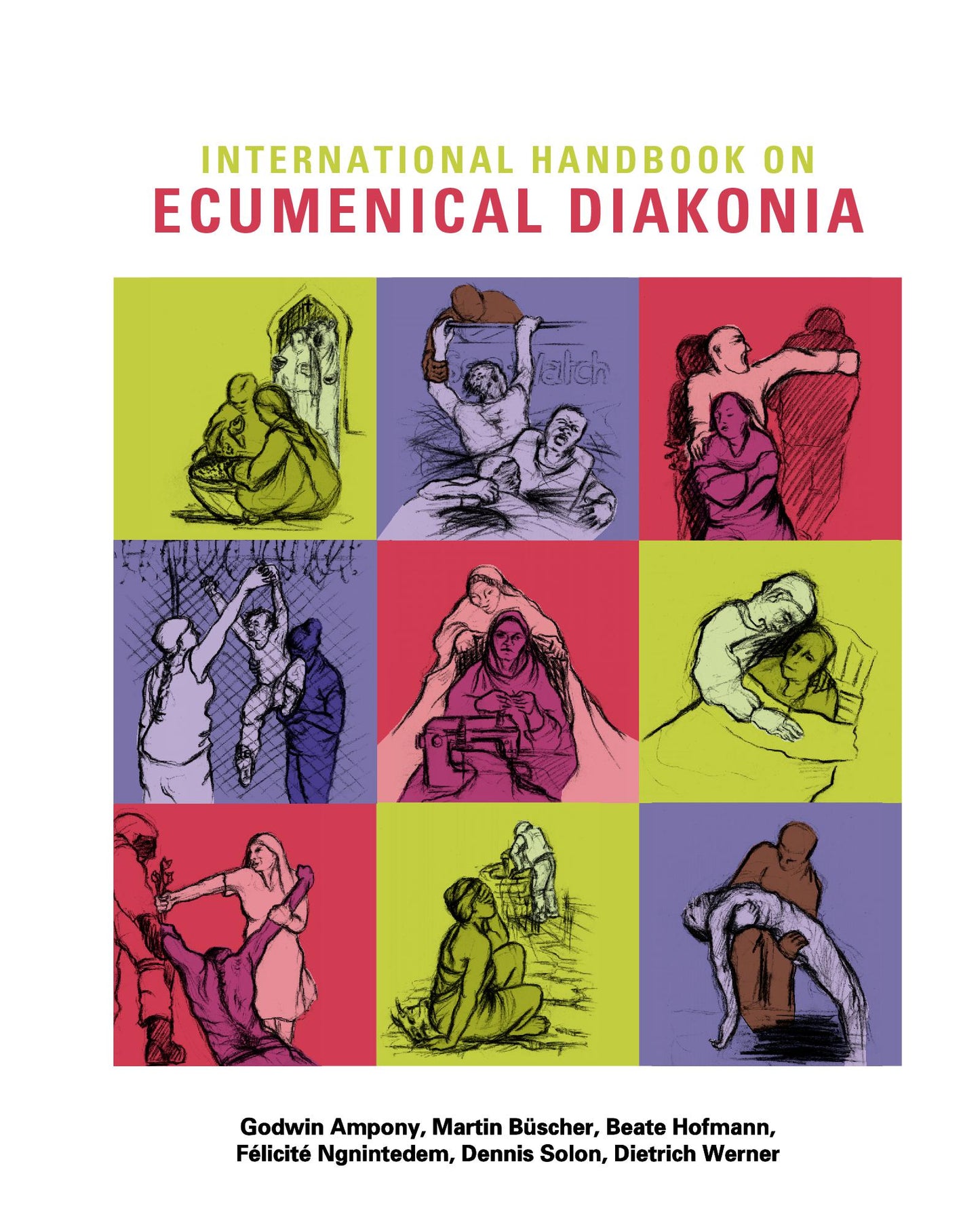

International Handbook on Ecumenical Diakonia
International Handbook on Ecumenical Diakonia
Godwin Ampony, Martin Büscher, Beate Hofmann, Félicité Ngnintedem, Dennis Solon, Dietrich Werner (Editors)
2021 | 764pp | ISBN 978-1-913363-91-8
Contextual Theologies and Practices of Diakonia and Christian Social Services – Resources for Study and Intercultural Learning
Training and education for Diakonia, for social care, support for the vulnerable, advocacy for those marginalized and suffering from injustices today needs high quality resources and intercultural, contextual as well as interdisciplinary approaches. This was the core conviction of major institutions of diaconal work and research in Germany and some of their international partners to come together in 2018 to plan for an International Handbook on Ecumenical Diakonia. Conceptualized together by the Institute for Diakonic Science and Management (IDM) in Bielefeld/Bethel, the United Evangelical Mission, an international communion of 38 churches in Africa, Asia and Europe, the v.Bodelschwingh Foundation, Bread for the World, Desk for Theology and Ecumenism, Diakonia Germany, the All African Conference of Churches (AACC), and also supported by the Desk for Ecumenical Diakonia in the World Council of Churches a project was developed to bring together key resources on biblical-theological foundations, regional and confessional expressions, new themes and trends and educational approaches and curriculum models for diakonia and Christian social services which can enrich current training courses for diakonia and widen the horizon by inter-contextual and inter-cultural perspectives.
An international editorial group consisting of Rev. Godwin Ampony, Prof. Martin Büscher, Bishop Prof. Beate Hofmann, Rev. Félicité Ngnintedem, Prof. Dennis Solon and Rev. Prof. Dietrich Werner (Convener) worked tirelessly to implement this project being accompanied by a wider international advisory group and members from the network Research in Diakonia. The emphasize was on ecumenical diakonia, i.e. approaches to Christian social services and social development work in many different denominational and cultural settings, the interconfessional and trans-national cooperation and joint action for diakonia between different churches and faith-based actors and the orientation towards the “whole inhabited earth” (oikumene) as the indispensable horizon and frame of reference for spelling out current mandates and profiles of church-based diakonia in the contexts of globalization.
The result of this three years process is a publication with around 100 concise introductory essays and regional survey articles from all major Christian traditions and regions in the world structured in four different sections:
I. Theologies of Diakonia in Different Ecclesial and Social Contexts
II. Concepts and Profiles of Diakonical Ministries in Different World Regions
III. Trends and Crucial Concerns in Diakonia
IV. Models and Methods for Competency Building in Diakonia
The Corona Pandemic, which has unfolded its global devastating impact during the second part of the editorial process for this project and has deeply influenced many of the contributions of this volume, had underlined the significance and “systemic strategic value” of the professions of care-giving, medical and social support as well as advocacy work for those left behind economically. It also has evoked a new sense of urgency for learning and education: relearning what is really essential and life-giving in our models of development. Learning from one another in terms of inter-contextual exchange about the art of providing care with dignity, love with justice, compassion with advocacy for the vulnerable has strongly come again on the agenda. Thus the volume will be facilitating learning, research and education in many churches and their seminaries, theological faculties and places of theological research around the globe in the future so as to equip churches for being a diakonos, a go-between person between a community and the marginalized, between the suffering or vulnerable and the powerful, building bridges of care and support, of resistance and hope in order that all may enjoy the fullness of life (John 10:10).
Table of Contents
Table of Contents
CONTENTS
Words of Greeting
Betty Cernol McCann, Zephania Kameeta, Ninna Edgardh, Rudelmar Bueno de Faria, Thorsten Göbel, Cornelia Füllkrug-Weitzel, Isabel Phiri xiii
Editorial
Godwin Ampony, Martin Büscher, Beate Hofmann, Félicité Ngnintedem, Dennis Solon, Dietrich Werner xix
Discovering and Learning from the Rich Diversity of Ecumenical Diakonia: Explanation and Meditation on the Cover Design
Beate Baberske, Corinna Smok, Achim Weinberg, Dietrich Werner xxix
List of Contributors xliii
PART I: THEOLOGIES OF DIACONIA IN DIFFERENT ECCLESIAL AND SOCIAL CONTEXTS
1. Florence Nightingale and Her Pioneering Role for Diaconia and Holistic Care in Humanitarian Emergencies
Cornelia Coenen-Marx 3
2. Terminologies, Learning Processes and Recent Developments in Ecumenical Diakonia in the Ecumenical Movement
Dietrich Werner and Matthew Ross 8
3. Main Biblical Themes of Diaconia from European Perspectives
Renate Kirchhoff 26
4. Different Shapes of Diakonia in Biblical Tradition from African Perspectives
Msafiri J. Mbilu 31
5. Diakonia in a Trinitarian Perspective and as Dimension of the Missio Dei
Kjell Nordstokke 37
6. The Diakonia Dei: Service of the World and Forms of Diaconal Ministry among Baptists
Darrell Jackson 43
7. Towards a Comprehensive Concept of Diaconia: Care, Transformation, Empowerment, Advocacy and Conviviality
Wanda Deifelt and Beate Hofmann 53
8. The Transformative Power of Diakonia – Theological Reflections from South Africa
Ignatius Swart 62
9. The Transformative Power of Diaconia – an Eight-headed Hydra
Cornelia Coenen-Marx 68
10. Vulnerability and the Quest for Healing among Migrants in Cape Town: Theological and Anthropological Reflections
Henrietta Nyamnjoh and Andrea Bieler 73
11. Diaconia and the Church – Towards a Diaconal Ecclesiology – Reflections from Orthodox and Protestant Perspectives
Stephanie Dietrich and Evangelos Thiani 81
12. Interpretation, Inspiration and Interruption: The Role of Theologies in Diaconia
Sturla J. Stålsett 95
13. Diaconia as Public Theology within a South African Context
Nadine Bowers du Toit 105
14. Interdisciplinarity and Contextuality Analysis in Diaconic Studies
Martin Büscher and Dennis Solon 111
15. Christian Social Service in Countries with a Predominantly Christian Tradition and State Church History
Ingolf Hübner 118
16. Christian Social Service in Minority Protestants Contexts and Secular States
Caterina Bain 123
17. Diaconia as Inclusivity: Living Community with the Excluded – A Biblical Didactic of Inclusion
Kambale Jean-Bosco Kahongya Bwiruka 132
18. The Diaconal Profile of Christian Social Services within Multicultural and Secularised Settings
Beate Hofmann and Annette Leis-Peters 139
PART II: CONCEPTS AND PROFILES OF DIACONICAL MINISTRIES IN DIFFERENT WORLD REGIONS
19. Patristic Approaches to Diakonia – Diakonia in the Ancient Mediterranean Region
John N. Njoroge 151
20. Social Ministry – Social Work with Drug-addicts in Pentecostal-Charismatic Churches in Russia
Tatiana Gorbacheva 159
21. Diakonia and Social Assistance in the Theology and Practice of the Romanian Orthodox Church
Ion Vicovan 163
22. Christian Social Services in the Serbian Context – A Brief Overview
Ilija Jovic and Dalibor Petrovic 168
23. The Understanding, Roots and Practices of Diakonia in the Coptic Orthodox Church
Bishoy Kamel 172
24. Diakonia in the Greek (Rum) Orthodox Tradition: The Context of Syria and GOPADERD
Alexi Chehadeh 179
25. Diaconia in Southern and Central African Christianity
Bosale E. Eale 186
26. Examples and Concepts of Diaconia in Southern African Christianity
Willie van der Merwe 191
27. Diaconia in West African Christianity
Confidence Worlanyo Bansah and Edem Dzunu 197
28. Examples and Concepts of Diaconia in West African Christianity
Emmanuel Kwesi Anim 203
29. Examples and Concepts of Diaconia in East African Christianity
Edison Muhindo Kalengyo 213
30. Diakonia in an Asian Context
Victor Aguilan 220
31. Diaconia and Sustainable Development in China
Theresa Carino 229
32. Diakonia across Borders: Interfaith Cooperation – A Case Study of Shanghai YMCA & YWCA in China
Jianrong Wu, Zhaozhen Ma and Ruomin Liu 234
33. Diakonia in Indian Christianity
Sushant Agrawal and Joycia Thorat 240
34. Diaconia and Conviviality in Central and Eastern Europe
Janka Adameová and Tsovinar Ghazaryan 247
35. Reformulating Diaconia in Western Europe: New Approaches and Theological Challenges
Erika Mejiers and Heather Roy 255
36. Diakonia in the Churches of Central America
Benjamin Cortes 263
37. The Diaconal Church in the Public Sphere in the Brazilian Context Today
Rudolf von Sinner 269
38. A Lutheran Theology for Diakonia in North American Contexts
Craig L. Nessan 279
39. North American Diaconia and the Deaconess Movement
Jenny Wiley Legath 289
40. Theological Reflection: Mission and Service of UnitingCare Australia
Ji Zhang 297
41. Diakonia as a Quest for Just and Peaceful Communities in the Pacific
James Bhagwan 305
PART III: TRENDS AND CRUCIAL CONCERNS IN DIACONIA
42. Diaconia and Human Dignity – South African Theological Perspectives
Nadine Bowers-Du-Toit 313
43. Diaconia and Human Dignity – Asian Theological Considerations
Dennis Solon 317
44. Peacebuilding in the Philippines: The Diaconal Engagement of the Church
Victor R. Aguilan 324
45. Diaconia as Peace and Justice Advocacy: A Philippine Perspective
Noriel C. Capulong 331
46. Diakonia in a World of Vulnerability – Some Public Theological Parameters
Nico Koopmann 336
47. Dynamics of Diaconia and Public Theology in the Post-Peace Society of Serbia
Rastko Jovic 345
48. Mutual Learning on Sustainability: Eco-Diaconia in Scottish – Hungarian Partnership
Tamas Kodacsy and Adrian Shaw 354
49. Towards an Eco-Diaconia in a Context of Displacement: Theological Impulses from Adivasi Communities in India
Christ Sumit Abhay Kerketta 358
50. Eco-Diaconia in Southern African Contexts – SAFCEI as an Example for a Multi-Faith Eco-Justice Response
Kate Davies 365
51. Diaconia and the Sustainable Development Agenda – Trends and Crucial Concerns
Chad Rimmer and Julia Brümmer 372
52. Diaconia and Poverty Reduction in Namibia: The role of the Evangelical Church in Namibia (ELCRN)
Janine van Wyk 378
53. Diaconia and Poverty Reduction: Diaconia and the Poor in the Presbyterian Church in Rwanda
Mathilde Umuraza 382
54. Poverty in the Midst of Wealth and Social Exclusion as a Diaconal Challenge – Reflections on Responding to Household-debt in the UK
Andrew Orton 388
55. Social Exclusion of the Poor Amid a Wealthy Society – Diaconal Challenges in Hong Kong
Kenneth Tsang 393
56. Conviviality as a Vision and Approach for a Diaconal Society
Tony Addy and Ulla Siirto 399
57. Diaconia of Orthodox Communities in the Context of Migration in Germany
Rossitza Dikova-Osthus 412
58. Migrants and Refugees: Voice and Agency. Towards an Infrastructure of Welcome and Hospitality and an Architecture of Advocacy and Solidarity
Liberato C. Bautista 417
59. Health and Healing in Diaconia
Thorsten Moos 427
60. Healing in the Church in Africa as Diakonal Praxis
Philomena Njeri Mwaura 431
61. Health and Healing as Key Concerns in Churches Diaconia in West Africa
Godwin Ampony 437
62. Mental Health as a Task of a Diaconal Church at the Local Level
Beate Jakob 444
63. Diaconia in Contexts of Traumatisation – An Introduction
Christine Gühne 452
64. Diaconia in Traumatised Societies: Learning from the Rwandan Context
Nagaju Muke 456
65. Diaconia as Peacebuilding and Reconciliation
Wendy Kroeker 468
66. Diaconia as Peacebuilding and Reconciliation
Vladimir Fedorov 475
67. Diaconia and the Challenge of Fundamentalism and Exclusivism
Aled Edwards 481
68. The Need for a Theology of Resilience, Coexistence and Hope
Antje Jackelén 485
69. Deliverance, Mental Health, and Prosperity: A Holistic Diaconal Perspective from Indonesian Context
Jaharianson Saragih and Parulihan Sipayung 490
70. Contours of Challenges for People Living with Disabilities in Local Churches with Examples from Cameroon
Félicité Ngingtedem 497
71. An Ecumenical Diaconal Response to Disability: The Journey of EDAN
Anjeline Okola 502
72. The Prosperity Gospel, HIV, And #Blessed: Diakonia as Liberating Praxis in the South African Context
Beverly Haddad 510
73. Addressing the Spatial Turn in Diaconia
Kaia S. Rønsdal 515
74. Social Responsibility in Monastic Orthodox Religious Communities
Vladimir Fedorov 520
75. Social Responsibility in Protestant Religious Communities – the Case of Kaiserswerth Association
Christa Schrauf 526
76. Social Services and Responsibility in Christian Religious Communities – the Example of Diakonia in World Federation
Sandy Boyce 531
77. Changing Patterns of the Family – Implications for the Future of Care
Cornelia Coenen-Marx 538
78. Ethics of Diaconia: The Relevance of Good Life, Common Good and Global Justice in Diaconia
Johannes Eurich 542
79. Transformative Diaconia: From Early Christianity to Development Concepts and Economic Globalisation
Jerry Pillay 548
80. Ecumenical Diakonia in the Context of COVID-19 – A Chance for Growing Collaboration between ACT Forums and Churches
Corrie van der Ven and Jørgen Thomsen 556
81. Christian Social Witness towards Polarization, Markets and Money – Pivotal Moments from the U.S. Context
Elizabeth Hinson-Hasty 563
82. Digitalisation in Diaconia – Description and Ethical Reflection
Melissa Henne 568
83. Care and Care Deficit
Christine Globig 573
PART IV: MODELS AND METHODS FOR COMPETENCY BUILDING IN DIACONIA
84. Current State of Diaconia Training with Special Focus on Urban Diaconia in South Africa, USA and China
Christoph Sigrist 581
85. Multi-Rational Management for Diaconic Leadership
Martin Büscher and Udo Krolzik 586
86. Liberation Theology and Diaconia: Methods of Learning
Craig L. Nessan 591
87. Abuse and Misconduct in Church Settings: Learning from the Dark Side of Diakonia History
Tormod Kleiven and Matthew Ross 597
88. Diaconal Church Development in Hong Kong: Theological Grounds, Contextual Challenges and Capacity Building
Kenneth Tsang 602
89. Building Diaconal Leadership in Different Contexts – African Perspectives
Bosela E. Eale 609
90. Building Diaconal Leadership in Different Contexts – Perspectives from the Argentinian Context and the Role of CREAS
Humberto Shikiya 614
91. Training for Social Services in Pentecostal Christianity – Discoveries in Ghana
Emmanuel Kwesi Anim 620
92. Training for Social Services in Orthodox Christianity
Vladimir Khulap 628
93. Seeing-Judging-Acting: A Learning Method for Empowerment in Diaconia from a Latin American Perspective
Carlos E. Ham 631
94. Methods for Engaging Youth with and for Christian Diakonia: the Case of the Living Generation Church
Elorm Nick Ahialey-Mawusi 639
95. Engaging Youth with and for Diaconia in Italy: from Peer Education to Social Work
Stefano Bertuzzi 645
96. Applying Liberating Pedagogy in Eastern and Central Europe – Innovative Learning Programmes for Diaconia by Interdiac
Oksana Prosvirnina 649
97. Didactics of Inclusion: Diakonia as a Round Table
Rodolfo Gaede Neto 653
98. Learning Diakonia in Organised Church Institutions – Biblical Principles for Training for Professional Diakonal Work
Kambale Jean-Bosco Kahongya Bwiruka 664
99. Christian Social Action and Global Citizenship Education
Gordon Zerbe 673
100. Financial Management and Resource Mobilisation in Diaconic Organisations
Bright G. Mawudor and Deborah Suparni 681
101. Global Learning for Diaconia – Rethinking Concepts and Praxis
Matthias Börner, Lusungu Mbilinyi and Angelika Veddeler 689
102. Curriculum Development for Diaconia and Training in Christian Social Services
Beate Hofmann 698
103. Diaconic Training in the Ev. Bildungsstätte für Diakonie und Gemeinde (v. Bodelschwingh Foundations Bethel, Germany)
Jutta Beldermann 705
104. List of Selected Bibliographical Resources for Contextual Diaconal Studies: Textbooks, Articles, Websites
Godwin Ampony and Félicité Ngingtedem 710
Preview Regnum Handbooks 714
About the Author
About the Author
Endorsements
Endorsements
This Handbook is an invaluable resource for students, educators, church workers and researchers as they grapple with community development challenges and collaborate with others in addressing needs across such fronts as health care, politics, ecology, religion and economics.
Betty Cernol McCann, President Silliman University, Dumaguete, Negros Oriental, Philippines
The importance of diaconia in our world cannot be emphasised enough, even more so in a world where so many things are taking place now; migration where people are trying to find a place and support there, or climate change affecting the poor of this world. Not only in the world, but also in Namibia, diaconia is important to reduce the suffering and give support to the poor.
Hon. Bishop (Emeritus) Dr. Zephania Kameeta SWAPO member of the National Assembly first Deputy Speaker of the National Assembly of Namibia
The First Minister of the Ministry of Poverty Eradication and Social Welfare of the Government of Namibia,Windhoek, Namibia
We live in a common household, where we need to take care of each other and of the earth, full of living creatures, that is our home. This insight is the basis for the Christian tradition which is sometimes given the Greek name diakonia, sometimes summarized as Christian social practice, but also appearing under any number of possible names. But the names as such are seldom important. What is crucial is the attitude transmitted from Jesus and his followers, that we have a responsibility, not only for ourselves, but also for our neighbour, and even more for those who are strangers to us, marginal or especially needy. Today these needy might be climate refugees or an animal species threatened by extinction.
Ninna Edgardh, Chair of The International Society for the Research and Study of Diaconia and Christian Social Practice (ReDi ) 2016-2020
The World Council of Churches warmly welcomes this publication and is glad to have had a part in its preparation, development and final publication and dissemination. The international perspectives of this book will challenge readers to look beyond local assumptions and horizons. I hope that it will help the processes of training, education and ethical orientation, thereby advancing the concept of ecumenical diakonia as we journey together on a pilgrimage of justice and peace.
Professor Dr Isabel Apawo Phiri, Deputy General Secretary – Public Witness and Diakonia
World Council of Churches, Geneva, Switzerland
Diakonia, service in action, is at the very heart of ACT Alliance – Action by Churches Together. Diaconal action is more and more claimed to be aimed at being rights- based, to promote human dignity and work for justice, peace and the integrity of creation. It includes prophetic diakonia, denouncing injustice (advocacy)b and announcing (actions) the ‘good news’ – in serving human need, breaking down barriers between people, promoting humanity in justice and peace, and upholding the integrity of creation, so that all may experience ‘fullness of life’ (John 10:10). We therefore congratulate and thank our member Brot für die Welt on this important publication, and commend it to the ACT Alliance membership and diaconal ministries at large.
Rudelmar Bueno de Faria, General Secretary, and Dr Thorsten Göbel, Director of Programmes, ACT Alliance
Additional Resources and Book Reviews
Additional Resources and Book Reviews
Share